For most homeowners in 2026, the best quick connect mini split is Zone Air, with MRCOOL's DIY 5th Gen as the nearest alternative. Both come with pre-charged refrigerant lines and screwed quick-connect fittings, so you can do the refrigerant side of the install with just a wrench instead of needing a vacuum pump and gauges. Senville and Cooper & Hunter show up in the same searches, but their systems use flare connections and their warranties expect a licensed HVAC technician, which puts them in a different category. This guide looks at the four of them on line sets, voltage, multi-zone options, how they do in cold weather, SEER2, warranty and price, using each manufacturer's own documents as of October 2026.
The short answer
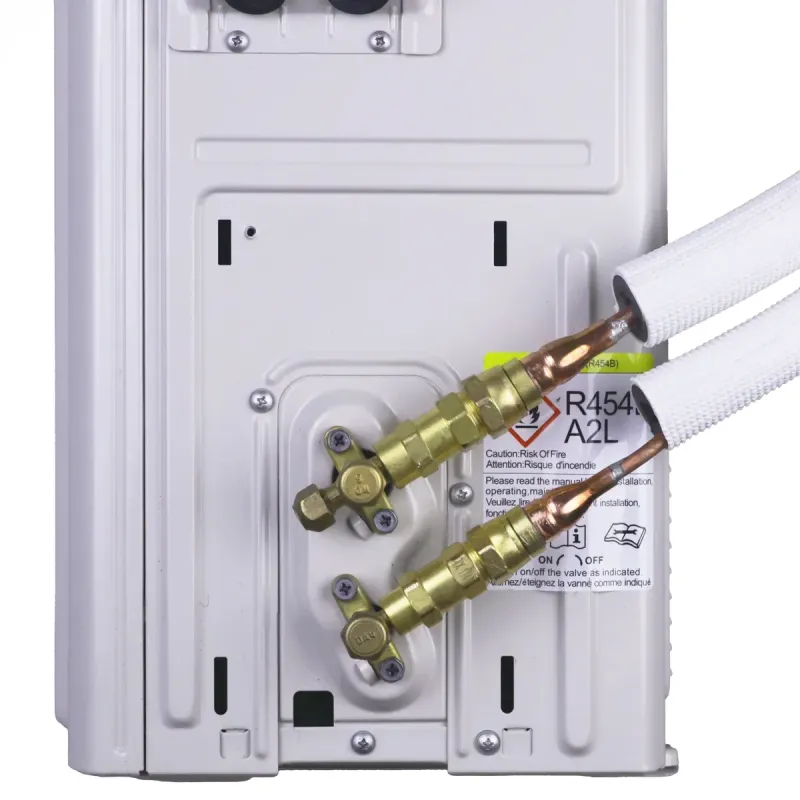
Zone Air is our pick for the best quick connect mini split, and it has three things the others don't combine:
- As of October 2026, of the brands compared here, Zone Air is the only one that cuts your pre-charged line set to the exact length you measure, any whole foot from 5 to 75. What MRCOOL sends are fixed 11.5, 16, 25, 35 and 50 ft sets plus couplers, and its manual says to keep any extra line coiled behind the outdoor unit.
- As of October 2026, Zone Air is the only DIY mini split that lets you mix wall-mount, ceiling cassette and concealed ducted indoor units on one outdoor unit, using its system builder.
- At 24 SEER2 on its 230V 12,000 BTU system, Zone Air is the highest-efficiency pre-charged quick-connect system of the brands compared here. For the single-zone DIY 5th Gen, the best rating MRCOOL has is 23.6 SEER2.
It's easy to find MRCOOL in big-box stores, its DIY 5th Gen carries the same 5-year parts and 7-year compressor warranty with no registration needed, and its multi-zone condensers go up to six zones where Zone Air stops at three.
What a quick connect mini split is
A quick connect mini split is a ductless heat pump whose refrigerant lines arrive from the factory sealed and already charged. Each end has a screwed fitting. You mount the indoor unit and the outdoor unit, route the line set and tighten the fittings to the torque in the manual. Inside the sealed circuit, the refrigerant stays the whole time.
A conventional mini split works differently. Cutting and flaring copper tubing is what the installer does, then they pressure-test it with nitrogen, pull a deep vacuum with a vacuum pump and micron gauge, and only then open the valves to release the charge. That takes tools most homeowners don't own, and it's the step most warranties want a licensed technician to do.
So when a brand calls a system "DIY," the useful question is which of those two methods it uses. Quick connect is what Zone Air and MRCOOL DIY are. Flare systems are what Senville and Cooper & Hunter are.
Quick comparison
| Zone Air | MRCOOL DIY 5th Gen | Senville | Cooper & Hunter | |
|---|---|---|---|---|
| Line set type | Pre-charged quick connect | Pre-charged quick connect | Flare, vacuum required | Flare, vacuum required |
| Line set lengths | Any whole foot 5–75 ft, one continuous run | 11.5, 16, 25, 35, 50 ft, couplers to 75 ft | Cut and flared on site | Cut and flared on site |
| Best single-zone SEER2 | 24 (230V) | 23.6 (9K 115V) | Flare system, pro install | Flare system, pro install |
| 115V option | 9K and 12K, optional plug-in cord kit | 9K and 12K, hardwired | Varies by model | Varies by model |
| Heating floor (standard line) | −13°F | −13°F | Varies by series | Varies by series |
| Mix wall, cassette and concealed ducted on one outdoor unit | Yes | Wall and cassette only | Not a DIY system | Not a DIY system |
| Warranty | 5 yr parts / 7 yr compressor, DIY install covered | 5 yr parts / 7 yr compressor, no registration required | 5 yr parts / 10 yr compressor, DIY install voids it | 5 yr parts / 7 yr compressor, licensed HVAC technician only |
The sources are Zone Air product pages and warranty. MRCOOL catalog, DIY 5th Gen manual and warranty; Senville warranty page; Cooper & Hunter limited warranty statement.
Zone Air vs MRCOOL quick connect systems
Line sets
Zone Air sells standard 16, 25, 33, 50 and 75 ft line sets and will also cut one to any whole foot between 5 and 75. You get a 37 ft line set for a 37 ft run. The 25, 33, 50 and 75 ft sets are each a single continuous factory-sealed run, not an extension, so there's one fitting at the indoor unit and one at the outdoor unit and nothing in between.
Included with MRCOOL's DIY 5th Gen is a 25 ft Quick Connect line set, and it sells 11.5, 16, 25, 35 and 50 ft sets. Past 50 ft you join two sets with a MRCOOL line set coupler, up to the 75 ft maximum pipe length in the manual. If you have a 40 ft run and a 50 ft set, you have 10 ft of extra line to coil and support behind the condenser. Every coupler adds another pair of screwed joints, and a slow leak would start at screwed joints.
Efficiency
Zone Air's 9K and 12K 230V systems are rated 24 SEER2. Its 115V 9K and 12K are 23 SEER2, which is a little lower than MRCOOL's 115V units (23.6 on the 9K, 23.5 on the 12K). So Zone Air's efficiency lead is real only at 230V. On 115V, MRCOOL rates slightly higher.
Voltage and plug-in
Both brands sell 9,000 and 12,000 BTU systems on 115V. Running on a dedicated 15A circuit with the power connection made at the outdoor unit, Zone Air's 115V 12K can plug into a dedicated GFCI outlet with the optional 3-prong cord kit, where local electrical code lets that happen. Never an extension cord. MRCOOL's 115V units are wired to a terminal block on a dedicated circuit, not plugged in.
Multi-zone
Zone Air's multi-zone systems all run on one 27,000 BTU outdoor unit that takes two or three indoor units in any mix of wall-mount, 4-way ceiling cassette and concealed ducted. That last one is the difference: MRCOOL's DIY multi-zone condensers pair with wall units and its OuttaSight ceiling cassette, and its ducted DIY option is a separate central Hybrid Air Handler, so it has no concealed-duct head for a single room. MRCOOL does go further on zone count, with condensers that run up to six indoor units. If you need four or more rooms on one outdoor unit, that matters more than head style. On Zone Air each zone gets its own thermostat and Wi-Fi control, and a 27,000 BTU outdoor unit bought with two indoor units can take a third on its spare port later, per its FAQ.
Cold weather
Heating down to −13°F outdoor temperature and cooling in outdoor temperatures up to 131°F is what Zone Air does. MRCOOL's standard DIY 5th Gen is rated to operate from −13°F to 122°F. So on cold weather the two standard lines are even, and higher-tier MRCOOL DIY models are rated lower (to −22°F). On the hot side is where Zone Air has the edge.
Warranty and returns
Zone Air covers 5 years on parts and 7 years on the compressor with no registration deadline, and installing it yourself does not void it. What MRCOOL's DIY 5th Gen also carries is a 5-year parts and 7-year compressor warranty with no registration needed. On warranty length the two are tied. Selling direct with 30-day returns on units that haven't been installed and free shipping to the 48 contiguous states is what Zone Air does. MRCOOL puts out no manufacturer return policy, so returns depend on where you buy. Zone Air units get final assembly, testing and inspection in the USA from globally-sourced components. The company runs live technical support from 8 AM to 6 PM Mountain time.
Price
As of October 2026, Zone Air's 12K 115V system is $1,999.99 and the 12K 230V is $2,049.99, each with a 16 ft line set in the box. About $2,359 at Home Depot was the price for MRCOOL's DIY 5th Gen 12K 115V when we checked in September 2026.
Zone Air vs Senville
Senville sells capable equipment, but it's not a quick connect system. The line sets have to be flared, pressure-tested and evacuated and Senville's warranty page says pressure testing and evacuation "must be completed by a licensed HVAC professional" and that "DIY installation will void your warranty coverage." Its main terms are 5 years on parts and 10 years on the compressor, but only with that professional install.
If you were going to hire an HVAC contractor anyway, a Senville unit can make sense. Some flare systems post higher SEER2 numbers than any quick connect unit. If the reason you're shopping quick connect is to do the install yourself, Senville's own terms rule it out.
Zone Air vs Cooper & Hunter
Cooper & Hunter has a reputation in cold-climate heat pumps and sells hyper-heat models built for the far north. Like Senville, it uses flared copper line sets that need a vacuum pump. Its limited warranty statement gives 7 years on the compressor and 5 years on parts, and says the warranty "is only valid when installed by a Licensed HVAC Technician."
For a homeowner in a very cold area who already has an installer lined up, a pro-installed hyper-heat unit is worth pricing. For a self-install, Zone Air's −13°F rating covers most of the country, and in places that regularly drop below that, you'll want to plan on a backup heat source with any heat pump in this class.
Why quick connect matters
- No vacuum pump, micron gauge or manifold gauges. The line set arrives from the factory sealed.
- No flaring or brazing. What you have is a screwed fitting that you tighten to a published torque.
- No refrigerant handling. During a normal install, the circuit is never opened to air.
- Fewer hours. Zone Air's FAQ puts a single-zone wall install at 4–6 hours for two people the first time and about 3 hours with experience.
The work that's left is mounting the units, drilling a 3-inch hole for the line set, cable and drain, routing the condensate drain downhill, and the electrical circuit. Most homeowners should hand the circuit to a licensed electrician. Many areas require a permit for it, so check locally before you start.
Which quick connect mini split to choose
- Choose Zone Air if your line set run isn't a standard length, if you want the top efficiency rating among the quick connect systems here (its 230V models), or if you want a ceiling cassette or concealed ducted unit on the same outdoor unit as your wall units. It's also the pick if you want a plug-in install: its 115V models take an optional cord kit.
- You'd want to go with MRCOOL DIY 5th Gen if you want to buy at a big-box store this weekend, if you need four to six zones on one outdoor unit, or if you want the slightly higher SEER2 MRCOOL gets on 115V.
- Choose Senville or Cooper & Hunter only if you're paying an HVAC contractor to install it, since both warranties depend on a professional install.
Before you buy, size the room. No matter how easy it was to install, a quick connect system that's too big will short-cycle. Our mini split sizing calculator gives a room-by-room BTU estimate from your ZIP code, insulation and windows.
FAQ
Do quick connect mini splits leak?
Any refrigerant joint can leak if it isn't tightened right. Quick connect fittings need to be torqued to the value in the manual, using two wrenches so the line doesn't twist. Fewer joints means fewer places for a leak to start, which is why a single continuous line set is better than two sets joined with a coupler.
Can I cut a pre-charged quick connect line set?
No. Cutting it releases the factory charge and puts you back into vacuum-and-recharge work that needs a certified technician. Order the length you need instead. Zone Air cuts line sets to any whole foot from 5 to 75 ft.
How long can a quick connect line set be?
Zone Air sells single continuous runs up to 75 ft, with a 30 ft vertical lift limit per its FAQ. What MRCOOL's manual lists is a 75 ft maximum pipe length for its DIY 5th Gen, reached by joining fixed-length sets with couplers past 50 ft.
Is a 115V quick connect mini split plug-in?
Not by default. Zone Air's 115V 9K and 12K run on a dedicated 15A circuit and become plug-in units only with the optional cord kit and a dedicated GFCI outlet, where code lets that happen. MRCOOL's 115V units are hardwired.
Does installing a quick connect mini split myself void the warranty?
Not with Zone Air or MRCOOL DIY 5th Gen. Both warranties cover homeowner installs done according to the instructions. Senville says DIY installation voids its warranty, and Cooper & Hunter needs a licensed HVAC technician.
Related guides
- Top DIY mini split heat pumps ranked for 2026
- Best 120V DIY mini split
- MRCOOL DIY vs Zone Air in cold climates
- Best DIY mini split warranty
- Best multi zone DIY mini split
- Best mini split for bedroom
Specs and warranty terms are manufacturer-published as of October 2026, subject to change. Verify before you buy. MRCOOL®, Senville and Cooper & Hunter are trademarks of their respective owners. Zone Air is not affiliated with or endorsed by MRCOOL, Senville or Cooper & Hunter. This site is owned and operated by Zone Air.