Choosing the best multi zone DIY mini split in 2025–2026 comes down to three questions: how many rooms do you need to cover, how cold does it get where you live, and can you handle the install yourself? This guide covers the top multi zone DIY mini split systems you can buy right now, shows them against pro-install standards from Mitsubishi and Daikin, and walks through sizing, installation and the mistakes that cost homeowners money.
Best Multi Zone DIY Mini Split Systems for 2025–2026
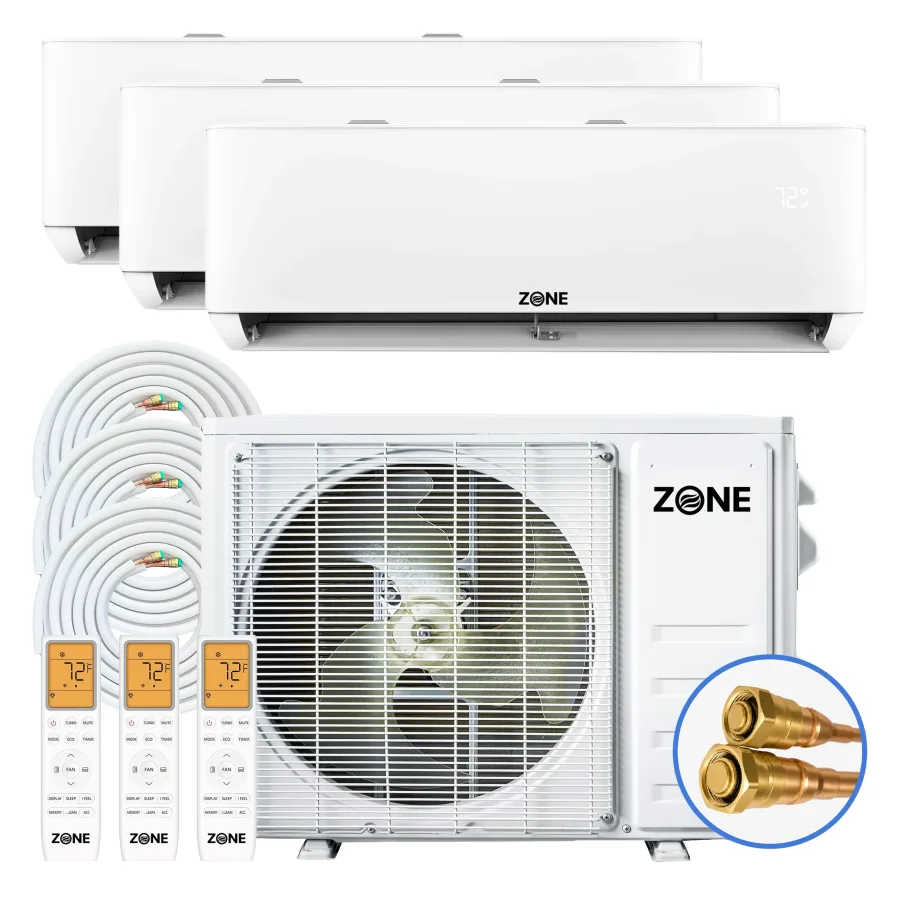
These are the systems that perform best across efficiency ratings, cold climate heating, true DIY installation and overall value for homeowners conditioning two or more rooms, making them strong choice for the best mini split depending on layout and climate.
- Zone Air Multi-Zone DIY Series (Best Overall): Wall-mount equipment runs $3,039.99 to $4,039.99 for 2-zone systems and $3,509.99 to $4,009.99 for 3-zone systems, plus one pre-charged line set per zone (from $229.99 for 16 ft). Every 2- and 3-zone system uses the same 27,000 BTU outdoor condenser, which takes up to 36,000 BTU of connected indoor capacity (e.g., 9k + 9k + 9k or 12k + 12k heads). On 230V wall-mount models the SEER2 is 24, so this is a good choice if you want to use less electricity and you plan to put it in yourself. Heating operates down to -13°F. The line sets are factory pre-charged with quick-connect fittings and they are cut to the length you need, and you won't need a vacuum pump. As of October 2026 it is also the only DIY mini split that lets you mix wall-mount, ceiling cassette and concealed ducted indoor units on one outdoor unit. This is the best fit for small to mid-size homes that want 2–3 zones put together on one floor or side.
- MRCOOL 5th Gen DIY Multi-Zone: Condensers range from 18,000 BTU (up to 3 zones) to 55,000 BTU (up to 6 zones), and SEER2 is 23.9 on the 18,000 BTU condenser and 23 on the 27,000 BTU condenser (MRCOOL catalog). On the 18,000–48,000 BTU condensers heating works down to -13°F, and on the 55,000 BTU it works down to -22°F (MRCOOL multi-zone manual). An 18,000 BTU kit with two 9k heads and two 16 ft line sets was $3,073 at HVACproSales in October 2026. This is a good choice for larger homes that need 4+ zones, though the install gets more complex with each additional head.
- Mitsubishi MXZ Hyper-Heat (Pro-Install Benchmark): This is not DIY. You can only get Mitsubishi's warranty if a licensed HVAC contractor installs the unit (Mitsubishi warranties). The system has full heating capacity at 5°F, and it is guaranteed to operate down to -13°F (Mitsubishi). This is included here so you can see what a top-tier pro system delivers and what you're giving up.
- Zone Air Thin-Air Concealed Ducted 2-Zone: This system has 20,500 BTU of connected indoor capacity (11k + 9.5k heads), 19 SEER2, and it supports about 1,025 sq ft across two zones. Rated heating to -13°F. This is likely the best choice when you want the install to be hidden. It can fit above ceilings or inside closets with short duct runs. As of October 2026 it's the only DIY concealed ducted mini split system on the market.
How Multi Zone DIY Mini Splits Work (One Condenser, 2–6 Indoor Units)
Multi-zone DIY mini split systems connect one outdoor heat pump to multiple indoor air handlers. Each indoor unit sits in a separate room, and each has its own thermostat. A single zone unit, by contrast, has one outdoor unit connected to one indoor unit for a single room.
The basic components are simple: the indoor and outdoor units work together through refrigerant lines, with the outdoor condenser housing the compressor and heat exchanger and each indoor head delivering conditioned air to its room. In true DIY systems from Zone Air and MRCOOL, those line sets arrive factory pre charged with refrigerant and end in quick-connect fittings. The refrigerant circuit stays sealed during the entire install.
Multi-zone systems give you independent climate control for each room through individual thermostats. Each indoor air handler can be set to different temperatures for customized comfort levels. One limitation is that all zones share a single mode at a time. The outdoor unit is running either heating or cooling for every connected head, so you cannot heat one room while cooling another on the same system.
Most residential multi-zone systems connect 2 to 5 indoor units, MRCOOL's largest DIY condensers take 6, and pro-grade condensers like the Mitsubishi MXZ can connect up to eight indoor units. Multi-zone DIY mini split systems can let you condition multiple rooms independently without ductwork. They generally provide year-round heating and cooling in one system.
Ductless mini splits are mounted directly on the wall and blow conditioned air into the room. Some systems, like Zone Air's Thin-Air line, are using short duct runs from a concealed indoor unit to ceiling or wall vents. Those ducted units need static pressure ratings and integrated condensate pumps, but they stay distinct from traditional central duct systems.
Best Overall Pro-Install Multi Zone Systems (Benchmarks for 2025–2026)
Even if you plan to install a DIY mini split, it helps to understand what the best professionally installed mini split systems deliver so you can set realistic expectations. Mitsubishi and Daikin are top choices if you want a pro to install your system.
- Mitsubishi MXZ Hyper-Heat: The MXZ Hyper-Heat multi-zone line keeps 100% heating capacity at 5°F, with guaranteed operation down to -13°F (Mitsubishi). One Mitsubishi multi-zone outdoor unit can connect up to eight indoor units (Mitsubishi). The warranty is only for units that are installed by licensed HVAC contractors (Mitsubishi warranties).
- Daikin AURORA MXT Multi-Zone: Daikin's newer AURORA MXT multi-zone systems use R-32 refrigerant, come in 2- to 5-zone configurations, and are rated up to 21 SEER2 and 10 HSPF2 (Daikin). Daikin ATMOSPHERA is a single-zone mini-split option in their larger product range (Daikin). Daikin's longer warranty terms need a licensed contractor install. Fujitsu AIRSTAGE XLTH, another pro-install option, operates down to -15°F (Fujitsu).
- Pros and cons of pro systems: Mitsubishi units and Daikin systems offer excellent cold weather performance, more indoor unit options (low-profile ducted, ceiling cassettes, floor mounts), and long warranties backed by contractor networks. The downside: you pay for contractor labor on top of the equipment, while a similar Zone Air DIY 3-zone kit is $3,509.99–$4,909.99 for the equipment. Pro systems are the performance ceiling. DIY systems close the gap at a much lower total cost.
Best Multi Zone DIY Mini Split Systems (True DIY vs "Pre-Charged Only")
A true DIY mini split in 2025–2026 comes with pre-charged quick-connect line sets that keep the refrigerant circuit sealed from factory to finished install. Pre-charged quick-connect line sets eliminate the need for professional HVAC installation in DIY systems. You never open the refrigerant circuit, so there's no refrigerant handling on your end. If a system only has a pre-charged condenser but empty or flare-fit line sets, you still need a vacuum pump, nitrogen test and often a licensed technician.
- Zone Air DIY Multi-Zone Series: The best DIY choice if you want 2–3 zones. All line sets ship pre-charged with R-454B and use quick-connect fittings at both the indoor unit and outdoor condenser. Each line set is cut to the length you order, anywhere from 5 to 75 ft. SEER2 is 24 on 230V wall-mount models. Heating operates to -13°F. Every 2- and 3-zone system runs on the same 27,000 BTU outdoor unit, with wall-mount heads in 9k, 12k and 18k options. You can mix wall, ceiling cassette and concealed ducted heads on it.
- MRCOOL 5th Gen DIY Multi-Zone: MRCOOL offers DIY multi-zone systems with pre-charged lines using R-454B. SEER2 is 23.9 on the 18,000 BTU condenser and 23 on the 27,000 BTU condenser. Supports up to 6 zones on its 48,000 and 55,000 BTU condensers (MRCOOL catalog). Heads come in wall-mount and OuttaSight ceiling cassette styles, plus a larger ducted DIY Hybrid air handler (MRCOOL Hybrid brochure), and line sets come in fixed lengths (11.5, 16, 25, 35 and 50 ft) joined with fittings for longer runs (MRCOOL catalog). Smartphone app control is standard. At 4+ zones, zone matching and wiring get more involved.
Watch for "pre-charged" labels that don't cover line sets. Many mini split systems sold in 2025–2026 only pre-charge the condenser. The line sets still arrive empty and need flaring, evacuation and charging by a licensed HVAC contractor. Before buying, confirm the listing says "factory-sealed quick-connect linesets."
For most 2–3 zone homes, a Zone Air DIY kit is preferable to a cobbled-together semi-DIY flare system. Quick-connect fittings follow standard torque specs, reducing leak risk. Plan on a full weekend for a first install, and you don't need a vacuum pump or brazing torch.
Zone Air Multi-Zone DIY Mini Split Review (Why Zone Air Is the Best)
With strong efficiency ratings, refrigerant connections that need no vacuum pump or brazing, and indoor and outdoor unit configurations at a lower total cost than hiring a contractor for a similar pro system, Zone Air leads the DIY multi zone market in 2025–2026.
- Efficiency and performance: Wall-mount multi-zone systems are rated 24 SEER2 on 230V models, with HSPF2 of 10.5 (Region IV). Cold-weather performance lets you heat in outdoor temperatures as low as -13°F. These numbers put Zone Air close to pro-install standards while costing thousands less.
- Configurations: Zone Air has 2- and 3-zone systems with wall-mount heads in 9k, 12k and 18k BTU sizes. Every 2- and 3-zone system uses the same 27,000 BTU outdoor condenser, supporting up to 36,000 BTU of connected indoor capacity. Indoor unit styles include wall mount, ceiling cassette (Airframe), and concealed ducted (Thin-Air). They can be mixed on one outdoor unit.
- True DIY features: The outdoor unit and all line sets arrive factory pre-charged with R-454B. Quick-connect fittings at both the condenser and each indoor unit mean the refrigerant circuit never opens during install. No vacuum pump and no brazing. Electrical requirements: 230V/30A dedicated circuit for multi-zone units.
- Smart controls: Each indoor unit comes with its own remote, and Wi-Fi app control is available for each zone, with scheduling. Smart controls let you schedule and monitor remotely for improved convenience and energy management. Wall-mount heads are rated at 30 dB, quiet enough for bedrooms and home offices.
- Value and warranty: Wall-mount 2-zone systems run $3,039.99–$4,039.99 for equipment in 2026, and 3-zone wall-mount systems run $3,509.99–$4,009.99. Ceiling cassette and concealed ducted 3-zone systems run $4,809.99–$4,909.99. Line sets are priced separately, from $229.99 per zone. Warranty: 7-year compressor, 5-year parts, with no registration cutoff. Zone Air's warranty covers homeowner installs done per the manual.
Zone Air's Main Advantages
Here's what Zone Air does that the other DIY brands in this guide don't, or don't do as well:
- Mix indoor unit styles on one outdoor unit. As of October 2026, Zone Air is the only DIY mini split that lets you put wall-mount, ceiling cassette and concealed ducted units on the same outdoor unit. A living room can get a wall unit, a kitchen a cassette and a bedroom a hidden ducted unit, all on one 27,000 BTU condenser. MRCOOL's DIY multi-zone combines wall and cassette heads with its larger ducted Hybrid air handler, but it has no slim concealed ducted unit.
- The only DIY concealed ducted mini split. Zone Air's Thin-Air units sit above a ceiling or in a closet and feed one or more rooms through short duct runs, so nothing is on the wall. As of October 2026 no other DIY brand sells a slim concealed ducted mini split.
- Line sets cut to the length you measure. Of the DIY brands here, Zone Air is the only one that cuts your pre-charged line set to the exact length you need, from 5 to 75 ft. MRCOOL sells fixed lengths (11.5, 16, 25, 35 and 50 ft) and fittings to join them (MRCOOL catalog), and Pioneer's line sets are pre-flared copper that needs a vacuum pump (Pioneer). An exact length means no extra coil of line set left behind the condenser.
- A third zone costs little more than two. Zone Air's 3-zone wall-mount systems start at $3,509.99, versus $3,039.99 for a 2-zone, because both run on the same outdoor unit.
- 24 SEER2 on every wall-mount multi-zone system. That's above MRCOOL's 27,000 BTU multi-zone condenser (23 SEER2), though MRCOOL's smaller 18,000 BTU condenser is rated 23.9 (MRCOOL catalog).
- Lower price at mid-size capacity. A Zone Air 2-zone with two 12k wall heads and two 16 ft line sets comes to $3,499.97. A similar MRCOOL 27,000 BTU kit with two 12k heads and two 16 ft line sets was $3,932 at HVACproSales in October 2026. At the small end MRCOOL is cheaper: its 18,000 BTU kit with two 9k heads and two 16 ft line sets was $3,073 there, versus $3,499.97 for Zone Air's 9k + 9k with two 16 ft line sets.
- DIY installs keep the warranty. Zone Air's 5-year parts and 7-year compressor warranty covers homeowner installs done per the manual, with no registration cutoff. Senville's warranty says DIY installation ends coverage (Senville), and Pioneer's longer coverage depends on signing up within one week of install (Pioneer).
- Final assembly, testing and inspection in the USA, from globally-sourced components.
- Live technical support from 8AM to 6PM MT, plus 30-day returns on systems that haven't been installed.
Other DIY Multi-Zone Brands
Comparing systems from other brands helps confirm that Zone Air is the best multi zone DIY option for you.
- MRCOOL DIY Multi-Zone: MRCOOL offers DIY-friendly mini-split systems with precharged lines and R-454B refrigerant. Their 5th Gen line supports up to 6 zones on its largest condensers, with smartphone app control standard, and heats down to -13°F (-22°F on the 55,000 BTU). Pricing depends on condenser size: at 27,000 BTU with two 12k heads MRCOOL runs higher than Zone Air, while its 18,000 BTU two-head kits are cheaper. MRCOOL's standard DIY 5th Gen warranty is 5-year parts and 7-year compressor with no registration needed (MRCOOL warranty). An Extended Limited Lifetime Replacement warranty is available through its paid Care Kit program (MRCOOL).
- Senville and Pioneer: Senville's Arctic Series is rated up to 25.5 SEER2 and heats to -22°F (Senville), but Senville and Pioneer multi zone systems don't ship as sealed quick-connect kits. Senville needs a licensed HVAC professional to pressure test and evacuate the line sets (Senville), and Pioneer's pre-flared line sets need a vacuum pump. These are not true DIY multi zone systems in the way Zone Air and MRCOOL define the category.
- Where other brands fit: If you plan to hire a contractor anyway but want budget-friendly equipment, Senville or Pioneer gear can work. For real DIY multi zone installation without professional tools, Zone Air and MRCOOL are the two best-known mini split brands with fully sealed, quick-connect multi-zone kits in 2025–2026. In our view Zone Air offers the simpler DIY path of the two, mainly because of its custom-length line sets and wider choice of indoor unit styles.
Multi-Zone vs Multiple Single-Zone Systems
Many homeowners in 2025–2026 debate whether to install one multi zone mini split or several single zone ductless mini splits. A single zone unit has one outdoor unit connected to one indoor unit. Single-zone systems are ideal for individual rooms or small spaces. The choice depends on room layout, how many outdoor units you can put up with, and when one unit makes more sense than several separate systems.
- Advantages of multi zone: Multi-zone systems connect multiple indoor units to one outdoor unit, meaning fewer outdoor units on your property, fewer wall penetrations, a cleaner exterior and simpler electrical rough-in. One outdoor condenser handles climate for 2–5 rooms.
- Advantages of multiple single-zone systems: Each single zone unit runs independently, so a compressor failure affects only one room. Part-load efficiency is often better because a single outdoor unit sized for one room adjusts its output more precisely. You can add zones as your needs change by expanding one system at a time. By contrast, a single outdoor setup changes the backup tradeoff differently than a multi-zone system because separate systems do not share the same condenser.
- When to choose which: Three adjacent bedrooms on the same floor are ideal for one multi zone system with a single outdoor unit. Distant rooms, separate buildings (garage, ADU, shop), or spaces on opposite ends of the house are better served by individual single zone units. Ductless mini-splits avoid energy loss usually associated with leaky ductwork in central HVAC systems, making either approach more efficient than replacing an existing system that relies on old central ducts.
Zone Air offers both single-zone and multi-zone DIY options. Multi zone makes the most sense when zones are put together within 75 feet of line set length from the outdoor condenser, on the same side or floor of the home.
How to Size a Multi Zone Mini Split
Accurate sizing of indoor units is critical to avoid short-cycling or wasted energy. With multi zone systems, you are sizing each head to its room and then matching the outdoor condenser to the combined load.
- BTU-per-square-foot rules of thumb: Mini splits are rated by BTU capacity for sizing. Room size affects the BTU requirements for mini splits. A 150–250 square feet room usually needs a 6,000 BTU unit. A 300–500 sq ft bedroom usually calls for 9,000–12,000 BTU. Mini splits usually come in capacities of 9,000 to 36,000 BTU. Use 20–30 BTU per square foot as a starting range, adjusting upward for hot or cold climates, poor insulation or west facing glass with heavy solar gain.
- Indoor heads first, then outdoor unit: Size each indoor unit to its room's square footage and load. Then choose an outdoor condenser that covers 75–100% of the combined indoor head capacity. Because peak loads rarely overlap across all rooms at the same time, Zone Air's 27,000 BTU condenser, for example, can support up to 36,000 BTU of connected indoor heads.
- Special loads to account for: South- or west-facing windows add solar gain. Kitchens produce internal heat. Ceiling height above 8 feet increases room volume. Basements lose heat through below-grade walls. Each factor can push the needed BTU per room up or down by 10–20%.
- Concrete sizing scenario: A 2,000 sq ft home with three rooms to condition: Room A at 400 sq ft, Room B at 300 sq ft, Room C at 500 sq ft. At about 25 BTU/sq ft: Room A needs about 10,000 BTU (round to a 12k head), Room B needs about 7,500 BTU (round to a 9k head), Room C needs about 12,500 BTU (round to a 12k head). Total connected indoor capacity: 33,000 BTU. Since 33,000 BTU is under its 36,000 BTU connected limit, Zone Air's 27,000 BTU outdoor condenser handles this load.
DIY vs Professional Installation in 2025–2026
Two paths exist: true DIY with a pre-charged system like Zone Air, or professional installation with traditional line sets, flare fittings and refrigerant handling. Simple configurations can help to avoid the need for professional installation completely, while still supporting year-round cooling and mini split heat.
- DIY project for a pre-charged system: Mounting indoor units on wall brackets, placing the outdoor condenser on a pad or wall mount, drilling wall penetrations (about 3-inch holes), running and tightening pre-charged line sets to the torque values in the manual, and connecting electrical wiring. For 230V circuits, many homeowners will call an electrician for the breaker and disconnect box. The rest is within reach of you if you are comfortable with basic tools. DIY installations still need proper drainage and electrical work.
- Tasks requiring a professional on non-DIY systems: Pulling vacuum on the refrigerant circuit to remove moisture, performing nitrogen pressure tests, brazing or flaring copper line sets, and charging with refrigerant under EPA Section 608 rules. Professional installation can ensure best performance and energy efficiency on these systems, but adds contractor labor to the project.
- Labor savings in 2025–2026: Installing a true DIY system yourself saves the contractor labor on a 3-zone install. Proper installation practices improve system reliability whether you hire out or do it yourself.
- Local codes still apply: Even with DIY ductless systems, some municipalities require electrical permits, mechanical permits or licensed contractor sign-off. Check code requirements in your area before starting.
Key Features to Compare in Multi Zone Mini Splits (2025–2026 Buyers' Guide)
Beyond brand names, a handful of specs determine whether a multi zone mini split will perform well and cost little to run.
- Energy efficiency: SEER measures seasonal cooling efficiency in mini-split systems. EER focuses on cooling efficiency under specific operating conditions. Higher SEER and EER ratings show better energy efficiency. SEER2 and EER2 are updated efficiency measures for mini-splits, and all 2025–2026 models are rated on the SEER2/EER2 scale. Mini-split systems often have SEER ratings above 20. High SEER2 energy efficiency ratings, often up to 24, can use about 40% less electricity than older SEER 14 central systems. For multi zone systems, aim for 22–25 SEER2 on wall-mount heads.
- Cold-climate heating output: You should look for systems that keep heating at 5°F and produce usable heating output down to -13°F or lower. This can matter in cold climates where the heat pump replaces a furnace as the primary heat source. Zone Air's and MRCOOL's DIY multi-zone systems both heat down to -13°F, and Mitsubishi's Hyper-Heat holds full capacity to 5°F.
- Indoor unit styles and noise: Indoor unit options include high-wall mounts, ceiling cassettes and concealed ducted units. Noise ratings for indoor heads usually fall in the low-to-mid 30s dB, with some models reaching the low 20s at minimum fan speed. Quiet operation matters in bedrooms and home offices. Rated at 30 dB, Zone Air's wall-mount heads are quiet enough for bedrooms and home offices.
- Controls and Wi-Fi connectivity: Many models include built-in Wi-Fi for easy integration into smart home systems. Look for per-zone scheduling, energy monitoring and compatibility with Alexa or Google platforms. Advanced inverter technology cuts energy spikes and improves overall efficiency in mini split air conditioners by running the compressor up and down rather than cycling on and off.
- Warranty and DIY eligibility: Some mini split brands void or reduce warranty coverage when the system is installed by a homeowner. Applying to homeowner installs done per the manual, Zone Air's warranty (7-year compressor, 5-year parts) covers DIY installs. MRCOOL's standard DIY 5th Gen warranty (5-year parts, 7-year compressor) needs no registration. Its paid Care Kit program adds an Extended Limited Lifetime Replacement warranty. Check warranty support terms before buying.
Operating Costs, Electrical Requirements and Your ZIP Code
Running cost depends on local electricity rates, climate zone and system efficiency.
- SEER2/HSPF2 and annual energy use: A 3-zone system with SEER2 of 24 uses about 40% less electricity for efficient cooling than a similar older SEER 14 system under the same load. For efficient heating, compare HSPF2 ratings. At seasonal average conditions, Zone Air's 10.5 HSPF2 (Region IV) means about 10.5 BTU of heat delivered per watt-hour consumed.
- Electrical requirements: Multi-zone systems usually need a dedicated 230V double-pole breaker for larger units. Mini-split systems usually need a dedicated electrical circuit. Most 2- and 3-zone DIY condensers run on a 230V/30A circuit. Some smaller single zone or 9k single-head Zone Air kits run on 115V. If your electrical panel doesn't have a spare 230V slot, an electrician will need to add one.
- Estimating costs by ZIP code: Use an online energy calculator that takes your ZIP code, insulation level and system SEER2/HSPF2 to estimate annual operating costs. Inputs include local heating degree days, cooling degree days and your utility's $/kWh rate.
- Payback in high-cost electricity states: In states like California, Massachusetts and New York, higher electricity rates mean a 24 SEER2 system pays back faster than it would in a low-rate state.
Mistakes to Avoid with DIY Multi Zone Mini Splits
Multi zone DIY installs are easier than pro-level HVAC work, but a few errors can tank performance or void your warranty.
- Oversizing or undersizing heads: Oversized mini splits can lead to inefficient operation. A head too large for its room short-cycles, running in brief periods that fail to remove humidity. A head too small cannot meet the load on peak days. Match each head to the room's square footage and thermal load.
- Poor line set routing: Kinking, sharp turns or going past the manufacturer's maximum line set length and height difference slows refrigerant flow and system capacity. Publishing maximum run lengths for each model, Zone Air gives you the specs to stay within. Staying within those specs keeps reliable performance and long term reliability.
- Skipping electrical code requirements: Using undersized wire gauge, omitting the required disconnect box, or wiring to an improperly sized breaker creates safety hazards. When in doubt, hire an electrician for the 230V circuit and disconnect.
- Ignoring condensate management: Every indoor unit produces condensation. Drain lines must slope downward or connect to a condensate pump. Concealed ducted units are especially vulnerable to leaks if drainage is not planned before installation.
- Not following the manual: Zone Air's install manual lists torque values for quick-connect fittings, mounting bracket placement and minimum space requirements. Following those steps keeps warranty coverage and reduces service calls. Even on DIY-friendly systems, professional maintenance can help preserve long-term performance. Systems using eco-friendly refrigerants like R-454B help reduce global warming potential, but those sealed connections must stay tight to keep the refrigerant where it should be.
Frequently Asked Questions About Multi Zone DIY Mini Splits (2025–2026)
Common questions from homeowners considering a multi zone DIY mini split purchase.
- How many zones can I run off one outdoor unit? Zone Air's DIY systems run 2 or 3 zones on one 27,000 BTU outdoor unit. MRCOOL's DIY condensers handle up to 3 zones (18,000 BTU) through up to 6 zones (48,000 and 55,000 BTU), per the MRCOOL catalog. Pro systems like the Mitsubishi MXZ can connect up to eight indoor units on a single outdoor unit.
- Can each indoor unit be set to a different temperature? Yes. Multi-zone systems allow independent temperature control in each room. Each head has its own thermostat or remote, providing personalized comfort room by room. The one limit is that all heads share a single heating or cooling mode set by the outdoor unit.
- Do DIY multi zone mini splits need a vacuum pump? True DIY systems like Zone Air and MRCOOL with pre-charged quick-connect line sets do not need a vacuum pump. MRCOOL says its Quick Connect line sets are pre-charged with R-454B with "no vacuuming required" (MRCOOL catalog). Systems with flare-fit or empty line sets still need evacuation and licensed refrigerant handling.
- What refrigerant do 2025–2026 systems use? New residential mini split systems are shifting from R-410A to lower-GWP refrigerants. Zone Air and MRCOOL use R-454B. Daikin's AURORA MXT line uses R-32. Both R-454B and R-32 have lower global warming potential than R-410A and meet current environmental regulations.
- When should I choose professional installation instead of DIY? Choose a pro install if the project involves panel upgrades or complex 230V electrical work, line set runs exceeding 75 feet, installations in multi-family buildings with strict permitting, or climates where temperatures regularly drop below -13°F and you need a cold climate system with a contractor behind it. Professional installation also makes sense when local codes require a licensed HVAC contractor to sign off on refrigerant-containing equipment.
- Can I add zones to a multi zone system later? Some systems support this. Adding zones as your needs change is possible, provided the outdoor condenser has unused capacity and available refrigerant ports. Zone Air's 2-zone and 3-zone systems use the same outdoor unit. Check with their team before buying if future expansion is planned.
Choosing the Best Multi Zone Mini Split
For most homeowners wanting a 2–3 zone DIY mini split system in 2025–2026, Zone Air is the best choice. Pre-charged quick-connect line sets cut to your length, 24 SEER2 on wall-mount systems, heating to -13°F, the option to mix wall, cassette and concealed ducted units on one outdoor unit, and a warranty that covers DIY installs make it the one we'd pick. Multiple capacities across their indoor unit range (9k, 12k, 18k) cover everything from a single room home office to a whole floor split across three zones.
- For cold climates or complex homes: Pro-install systems like Mitsubishi MXZ Hyper-Heat or Daikin Aurora deliver top-tier cold climate heating and more head form factors. Worth it for homes where extreme weather regularly pushes below -15°F or where 4+ zones are needed.
- Before ordering: Map each room's square footage and direction. Check your electrical panel for a spare 230V/30A slot. Confirm local code requirements for permits and electrical work. A load calculation based on your home's insulation, ceiling height and window exposure will prevent costly size changes later.
- Next step: Compare a specific Zone Air multi zone package against a local contractor's quote for a similar pro-install system. Factor in equipment cost, labor, operating cost over 10 years using your local electricity rate, and warranty terms. For most 2–3 zone homes, the Zone Air DIY path delivers the same personalized comfort at a much lower total project cost.
Specs, prices and warranty terms are manufacturer-published as of October 2026 and subject to change. Verify before you buy. MRCOOL® is a trademark of its owner; Zone Air is not affiliated with or endorsed by MRCOOL.
Related guides
- Best 3-zone DIY mini split
- Best 2-zone DIY mini split systems
- Best DIY easy-install multi zone mini split
- Multi zone mini split calculator
- 3 zone DIY mini split installation
- Best dual zone precharged mini split
- DIY multi zone concealed ducted mini split
- Best DIY mini split warranty
Zone Air specifications, prices and warranty terms are taken from Zone Air’s product and warranty pages as of October 11, 2026. MRCOOL, Mitsubishi, Daikin, Fujitsu, Senville and Pioneer facts are from each manufacturer’s own documents, linked inline, checked October 11, 2026; MRCOOL kit prices are from HVACproSales on that date. All are subject to change; verify before you buy. MRCOOL® is a trademark of its owner; Zone Air is not affiliated with or endorsed by MRCOOL.