In 2026, the best DIY dual zone mini split with precharged line set comes down to real specs, not what the ads say. This guide goes through the official specifications, performance data and installation details for dual zone pre-charged ductless mini split systems that you can get right now, and Zone Air is our top pick.
Best Dual Zone Pre-Charged Mini Split for 2026
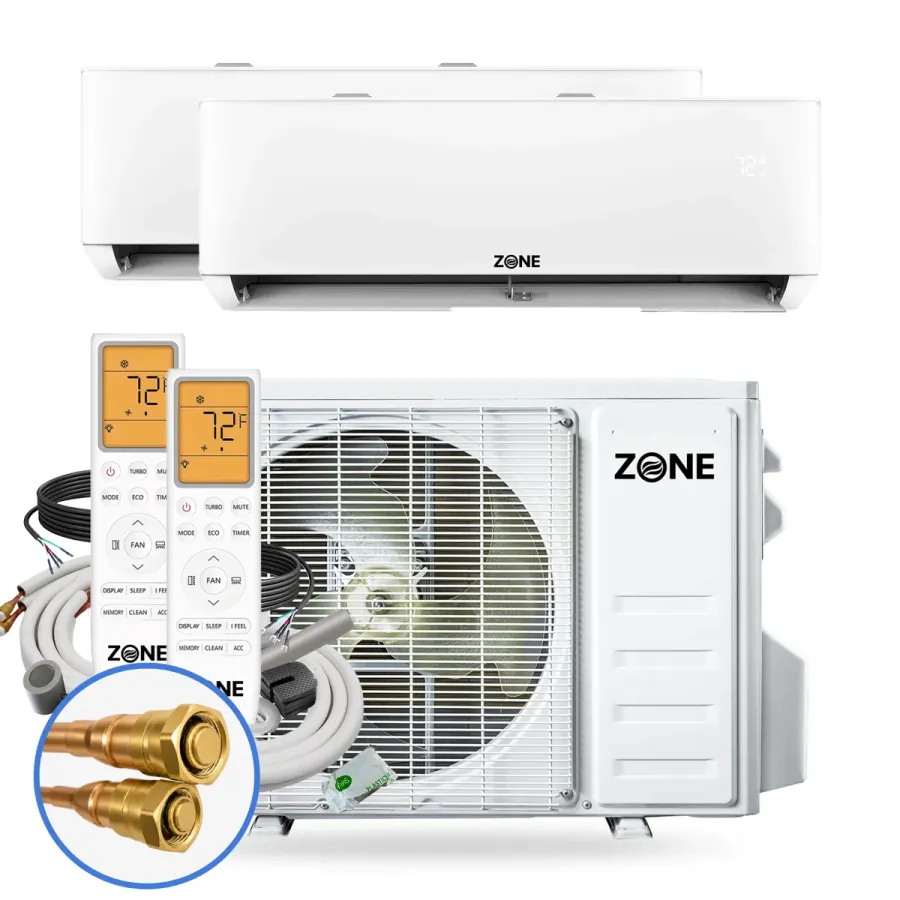
With 24 SEER2 cooling efficiency and factory pre-charged line sets that let you do a DIY installation, the Zone Air Dual Zone 36,000 BTU (2×18,000 BTU) Pre-Charged Ductless Mini Split is our pick for the best dual zone precharged mini split for 2026, so you don't need an HVAC contractor.
Here are the official specs that matter:
- Total connected capacity: 36,000 BTU (two indoor heads that are each 18,000 BTU)
- Outdoor condenser rated capacity: 27,000 BTU cooling / 28,000 BTU heating
- SEER2 cooling efficiency: 24
- HSPF2 heating efficiency: 10.5 (Region IV) / 8.8 (Region V)
- Minimum outdoor operating temperature (heating): −13°F
- Refrigerant: R-454B, factory pre-charged
- Line sets: pre-charged quick-connect, sold separately, one for each zone, in standard lengths of 16 ft, 25 ft, 33 ft, 50 ft and 75 ft
- Indoor noise: 30–44 dB. Outdoor noise: 62 dB(A)
- Warranty: 5 years parts / 7 years compressor
- Price: $4,039.99 for the system, plus line sets
Dual-zone precharged mini split systems let you control the climate independently in two separate rooms, so this setup works well for a main living area plus a bedroom, or two large rooms that total up to 1,800 sq ft.
Zone Air is the best option for homeowners who want dual zone ductless comfort without hiring an HVAC tech. It handles both cooling and heating year-round. Later sections compare it with other 2026 dual zone ductless systems and explain how to read official specification sheets.
How Dual Zone Precharged Mini Splits Work
A dual zone ductless mini split can use one outdoor unit (the compressor and condenser) to feed two indoor air handlers through refrigerant lines. Each indoor unit has its own thermostat, so you can get precise temperature control in two rooms from one outdoor condenser.
"Precharged" in 2026 means the factory loads R-454B refrigerant into sealed, quick-connect line sets before it sends them to you. These systems don't need professional vacuuming or refrigerant handling. You can thread the fittings by hand, and the sealed charge will handle the rest. Zone Air sells pre-charged line sets from 16 ft up to 75 ft for each zone, and it can cut a custom length anywhere from 5 ft to 75 ft.
One of the main things that sets modern dual-zone mini split systems apart is independent temperature zoning. One indoor head can run at 72°F in the living room while the other keeps the bedroom at 68°F. A single zone system can't do this, and central air handles the whole house as one thermostat.
Compared to window units, modern mini splits are quieter, more efficient and they look cleaner. Ductless systems also skip the duct losses that central systems can have. If you care about design, the wall-mounted indoor unit replaces the bulky window box completely.
2026 Official Specification Snapshot for the Zone Air Dual Zone 36K (2×18K) Pre-Charged System
The Zone Air 36,000 BTU dual zone wall-mount system runs on 208-230V / 60 Hz with a 30A double-pole breaker. The full spec sheet is explained in plain language below.
| Specification | Value |
|---|---|
| Model year | 2026 |
| Indoor units | 2 × 18,000 BTU wall-mount heads |
| Outdoor rated capacity (cooling) | 27,000 BTU |
| Outdoor rated capacity (heating) | 28,000 BTU |
| SEER2 | 24 |
| EER2 | 12.0 |
| HSPF2 (Region IV / Region V) | 10.5 / 8.8 |
| Refrigerant | R-454B, factory pre-charged |
| Line set type | Quick-connect, sealed, sold separately |
| Line set lengths | 16, 25, 33, 50 or 75 ft per zone (custom cuts 5–75 ft) |
| Indoor sound level | 30–44 dB |
| Outdoor sound level | 62 dB(A) |
| Heating operating range | Down to −13°F outdoors |
| Cooling operating range | 5°F to 131°F outdoors |
| Outdoor unit weight | 119 lbs |
| Warranty | 5 yr parts / 7 yr compressor |
| Price | $4,039.99 |
SEER2 ratings measure how efficiently air conditioners cool with the updated 2023 DOE testing procedures. HSPF2 ratings measure how efficiently heat pumps heat, using the same updated testing approach. Zone Air uses R-454B across its 2026 dual zone models, which is part of the HVAC industry shift toward refrigerants with lower global warming potential.
The outdoor rated capacity is 27,000 BTU, which is lower than the combined indoor head capacity of 36,000 BTU. This reflects real-world load variation because both zones rarely peak at full output at the same time. Every Zone Air two and three zone system has this same 27,000 BTU outdoor unit. Only the indoor heads change.
With concealed ducted (Thin-Air) dual-zone models, Zone Air also has options for homeowners who prefer hidden indoor units with slim vents. These come at 19,000 BTU (9.5K + 9.5K), 20,500 BTU (11K + 9.5K) and 22,000 BTU (11K + 11K). These concealed systems are rated 19 SEER2, with an HSPF of 10 to 10.5 on Zone Air's spec sheets.
You also don't have to pick one style for both rooms. Zone Air lets you mix wall-mount, ceiling cassette and concealed ducted indoor units on the same 27,000 BTU outdoor unit, two or three of them in any combination, through its system builder. So the bedroom can get a hidden ducted unit and the living room a wall unit, and it's still one outdoor unit and one DIY install. As of October 2026, it's the only DIY mini split that lets you mix all three styles on one outdoor unit.
Cooling and Heating Performance and Room Coverage
Zone Air rates an 18,000 BTU indoor head for up to 900 sq ft. A 12,000 BTU indoor unit usually covers 350-550 sq ft in moderate climates. Two 18K heads on the Zone Air 36K system can serve up to 1,800 sq ft across two zones.
For the concealed models, Zone Air's coverage ratings break down as follows:
- 19,000 BTU (9.5K + 9.5K): up to 950 sq ft total (475 sq ft + 475 sq ft)
- 20,500 BTU (11K + 9.5K): up to 1,025 sq ft total (550 sq ft + 475 sq ft)
- 22,000 BTU (11K + 11K): up to 1,100 sq ft total (550 sq ft + 550 sq ft)
The outdoor condenser is sized for realistic loads that happen at the same time. If you run both zones at maximum cooling on the hottest day of the year, the 27,000 BTU outdoor unit splits its capacity across both heads. In practice, bedrooms and living spaces rarely demand full output at the same time.
Matching BTU to room size matters. An oversized unit short cycles, running brief periods that fail to dehumidify properly. A small unit runs continuously during extreme heat without reaching setpoint. Lean toward the lower end of coverage ranges for mild climates. Size toward the upper end for cold climate zones so you've got enough heating output as outdoor temperatures drop.
Proper installation and correct BTU sizing keep cooling efficiency high and prevent the comfort problems that come with short-cycling.
What SEER2 and HSPF2 Mean for Your 2026 Bills
The seasonal energy efficiency ratio (SEER2) measures how many BTUs of cooling a system delivers per watt-hour of electricity over a full season. HSPF2 does the same for heat output. These are the official 2026 standards for comparing any ductless mini split or heat pump.
At 14.3 SEER2 and 7.5 HSPF2, the federal minimum for a new split-system heat pump is well below the Zone Air 36K dual zone rating of 24 SEER2, which puts it near the top of DIY multi zone systems.
For a home that's cooling with an older 10 SEER central AC system, a 24 SEER2 ductless system will use about half the electricity or less for the same cooling load, on paper. That means lower energy bills.
Inverter compressor technology is the reason. Fixed-speed compressors cycle on and off, but inverter-driven compressors vary output continuously so they match the load. Variable-speed fans in each indoor unit do the same. Running one zone at low speed while the other is off uses far less electricity than running a whole-house system.
The federal Section 25C tax credit for heat pumps ended for equipment placed in service after December 31, 2025. State and utility rebates may still apply, so check your local plan before buying.
Cold Climate Dual Zone Ductless Heating Specs
Zone Air's dual zone models operate down to −13°F outdoors, which covers most of the United States. Ductless heating performance in winter separates adequate mini splits from year-round heating solutions.
Some cold-climate models from other brands are rated to operate down to −22°F. Standard ductless systems without cold climate enhancements lose heating capacity faster as outdoor temperatures drop. Buyers in cold climate zones (IECC zones 5-7) should pick models specifically rated for low-ambient operation, or plan for backup heat below the system's rated minimum.
Dual zone ductless heating can reduce or replace electric resistance heaters, oil furnaces or propane systems. Heat pump technology moves heat rather than generating it from combustion. It can deliver about 2 to 4 units of heat for every unit of electricity it uses. Compared with electric resistance heat, that can cut heating energy use by half or more, depending on the weather.
Ductless mini splits in 2026 count as high efficiency heat pumps and are often eligible for state or utility rebates.
Pre-Charged DIY Installation and What Comes in the Box
Zone Air dual zone kits are engineered for DIY installation, with factory pre-charged line sets and quick-connect fittings that remove the two biggest barriers to your installation: refrigerant handling and vacuum pump equipment.
A 2026 Zone Air dual zone wall-mount system includes:
- One outdoor unit (condenser/compressor)
- Two indoor units (wall-mount)
- Two remote controls
- WiFi control for each zone
The pre-charged line sets (R-454B, one for each zone) are ordered separately in the length you need and are not included in the base kit. Concealed models include built-in condensate pumps.
The main DIY mini split installation steps are:
- You will mount the indoor units on the wall
- Drill wall sleeves for the refrigerant line connections and for the condensate drainage
- Route the pre-charged line sets from the indoor heads to the outdoor unit
- Set the outdoor condenser on a pad or on a wall bracket
- Hand-thread the quick-connect fittings
- Connect the electrical wiring (208-230V, 30A double-pole breaker)
Many areas require electrical and mechanical permits. Even with a DIY approach, local code may require a licensed electrician for the service disconnect.
Zone Air's warranty states that DIY installation does not void coverage, as long as you install the system per Zone Air's instructions, applicable codes and required permits. Don't cut or modify the pre-charged lines.
Noise Levels, Air Quality and Everyday Comfort
Quiet operation and air quality are as important as raw BTU output for living spaces where you sleep, work or relax.
At 30 dB on low fan speed, Zone Air's 2026 dual zone wall-mount indoor heads are similar to a quiet library. On high speed, they are at 44 dB. The outdoor unit is rated 62 dB(A), about the volume of a normal conversation.
Zone Air lists 26–40 dB per unit for the 22K concealed ducted system and 35–42 dB for the 19K and 20.5K systems.
Ductless systems avoid the dust and air leakage that ductwork can bring. Each indoor unit has a washable filter. Clean filters regularly to maintain airflow because a clogged filter makes the system work harder and drops efficiency.
Inverter-driven operation holds room temperatures more stable than on-off cycling window units. Dehumidification mode pulls excess moisture without too much cooling, which helps comfort in humid climates.
Smart Controls and 2026 Connectivity Options
Zone Air dual zone systems give you scheduling, remote access and independent control of both zones from anywhere through a smartphone app with WiFi control for each zone. You will also get a remote for each indoor unit.
Smart features directly improve energy efficiency. Set-back schedules lower output when rooms are empty, and pre-conditioning starts heating and cooling before you arrive home. There is also a 24-hour programmable timer, ECO mode and a sleep mode.
Third-party smart thermostats designed for ductless mini splits exist, but Zone Air's own app and remote controls handle scheduling, mode switching and temperature monitoring for both zones without extra hardware.
2026 Costs for Equipment, DIY Savings and Running the System
Zone Air pre-charged single zone systems start at $1,899.99 (9K, 115V). Here's how the math works out for a dual zone setup. The pro-install labor figure is a stand-in, so get local quotes because prices vary a lot by region.
At $4,039.99, the 36K (2×18K) dual zone system needs its own pre-charged line set for each 18K zone: $279.99 for 16 ft, up to $1,038.99 for 75 ft.
| Cost category | Pro install (traditional brand) | DIY (Zone Air 36K, two 16 ft line sets) |
|---|---|---|
| Equipment | Varies by brand | $4,039.99 |
| Line sets | Usually part of the install | $559.98 |
| Labor | Local quote (e.g. $1,000-$3,000) | $0 (your time) |
| Permits/inspection | Local fees | Local fees |
| Vacuum pump/gauges | Part of the labor | Not needed |
The DIY savings are whatever the installer would have charged for labor. Monthly energy bills drop as well: at 24 SEER2, cooling costs can come in around half of a 10 SEER central AC system for the same load.
State and utility discount plans for high efficiency ductless systems stay active in many states. Check your local utility's discount list before buying, and read the efficiency rules each plan needs.
Sizing Two Zones and Planning the Layout
Each indoor unit should be sized for its specific zone, not for the whole house. Use these rules of thumb for dual zone mini split sizing:
- 9,000 BTU indoor unit: about 250 to 400 square feet
- 12,000 BTU indoor unit: about 400 to 550 square feet
- 18,000 BTU indoor unit: it is about 550 to 800 square feet, depending on insulation and climate
Keep the combined rating of both indoor units close to the rated capacity of the outdoor condenser. For example, two 12k units add up to 24,000 BTU, and that fits comfortably under a 27k condenser. A 2-zone MRCOOL DIY system can often handle a slight size bump on one zone as long as the match appears in MRCOOL's combination table. Zone Air's 27,000 BTU outdoor unit takes connected indoor capacity up to 36,000 BTU. If you live in a hot southern climate, lean toward the higher end of each range. In cold climates where heating is the priority, consider stepping up one size to ensure the system handles peak demand. Tonnage reference: 12,000 BTU is equal to one ton of cooling capacity. Our sizing calculator gives you a BTU figure for each room before you shop.
Accurate room and zone planning is the single most important step before you shop. Measure first, buy second. For each zone, take these steps:
- Measure the room's square footage (length × width)
- Note ceiling height, number of exterior walls, window count and size and insulation quality
- Identify the best wall for mounting the indoor unit, ideally an exterior wall near where the line set will route to the condenser
- Sketch a simple floor plan and show both zones, where the outdoor unit will go, and the paths the line sets might take
Here is how to plan your routing:
- Measure the straight-line distance from each indoor unit location to the outdoor condenser
- Add footage for horizontal runs that go through walls or soffits
- Account for vertical rise if you are running lines to a second floor or through an attic
- Include extra slack for gentle curves, service loops and to get around obstacles
- Respect the minimum bend radius to prevent kinking, especially on the larger gas line
Plan the path for both zones at the same time so the line paths don't run into each other, and note where you'll put line hide covers on the outside so it looks clean when you're done.
Room Placement and System Layout
Smart indoor unit placement gets the full value from a dual zone system. Poor placement uses up capacity and creates uneven temperatures.
Practical guidelines:
- Be sure to leave the ceiling and side space listed in the installation manual
- Choose walls that keep the refrigerant line runs short
- Avoid placing units in direct sunlight or above heat sources
- You will keep furniture and curtains out of the airflow in front of the unit
Common two-zone setups for dual zone systems:
- Living room + primary bedroom: the two rooms that matter most for comfort
- Upstairs + lower floor: separate floors with different thermal loads
- Two opposite sides: L-shaped or ranch homes where central air leaves far rooms with too little air
Condensate drain lines also matter: each indoor unit needs a steady downward slope to its drain line. Sloppy drain line work causes water backups, wall damage and mold growth.
Official MRCOOL DIY 2-Zone Options for a Precharged Install
MRCOOL DIY multi-zone condensers can support two to six indoor units on a single condenser. For a dual zone setup, you'll usually look at the smaller end of the multi-zone condenser list. Here are the main options and example matches, with the catalog's coverage figures:
- 18k BTU condenser (DIY-MULTI3-18HP230D-O): This works with two 9k BTU wall-mounted air handlers. It's rated for up to 750 square feet total, so it's a good fit for two small bedrooms or a home office plus a guest room, each around 250 to 400 square feet. 23.9 SEER2.
- 27k BTU condenser (DIY-MULTI4-27HP230D-O): Works with two 12k BTU indoor units. It's rated for up to 1,125 square feet total, which covers a living room of about 500 square feet and a bedroom of about 400 to 550 square feet. 23 SEER2.
- 36k BTU condenser (DIY-MULTI5-36HP230D-O): This one works with one 18k and one 12k indoor unit, or with two 18k units if you have a large open area. It's rated for up to 1,500 square feet total, so it can handle a master suite and a generous living or dining area. 23 SEER2.
MRCOOL DIY multi-zone systems take two indoor unit types, wall-mounted air handlers and the OuttaSight ceiling cassette. MRCOOL's OuttaSight is a 50-inch single-slot cassette that sends air out one way. As for a concealed-duct DIY unit, MRCOOL does not sell one. Each MRCOOL line set comes with the DIYPro communication cable for talking between the indoor and outdoor units.
MRCOOL DIY line sets are available in standard lengths of 11.5, 16, 25, 35 and 50 feet. They cannot be cut or field-flared. If you need additional length, MRCOOL offers Quick Connect line set couplers that join two sets. The multi-zone manual caps each indoor unit's run at 75 feet, with 172 feet total on the 18k condenser and 221 feet on the 27k and up, a 33-foot height difference between indoor and outdoor units, and 24 feet between indoor units. Excess line gets coiled behind the condenser. With the diameter of the line set, it depends on the size of the indoor unit: 6k, 9k and 12k units use 1/4-inch liquid by 3/8-inch gas lines, while 18k units step up to 1/4-inch by 1/2-inch.
MRCOOL DIY multi-zone condensers run on a dedicated 208/230V circuit. The manual's wire table lists 16A minimum circuit ampacity and a 20A max fuse for the 18k, 23A/25A for the 27k, and 30.5A/35A with 10 AWG minimum wire for the 36k. Plan on a licensed electrician for that circuit.
MRCOOL DIY multi-zone condensers from 18k through 48k are rated to heat down to -13°F. Only the 55k reaches -22°F. Zone Air's dual-zone systems have that same -13°F floor. With no registration needed, the MRCOOL DIY 5th Gen warranty gives you 5 years on parts and 7 years on the compressor, starting from the proof-of-purchase date, and parts coverage includes the handheld remote, the Wi-Fi dongle and the pre-charged line sets. MRCOOL's DIY Select line has 1 year on parts and 2 years on the compressor, so make sure you confirm which line you are buying. With a Wi-Fi dongle, the system connects to your network for smartphone app control, and MRCOOL lists Alexa and Google Assistant voice control.
Zone Air vs MRCOOL DIY for a 2-Zone Precharged Line Set Install
Zone Air is the other pre-charged quick-connect DIY brand to put next to MRCOOL for a 2-zone project. Every Zone Air 2-zone and 3-zone system runs on one 27,000 BTU outdoor unit. What the BTU means in the product name is the connected indoor capacity. Here's where the two differ.
| Spec (2-zone, published October 2026) | Zone Air | MRCOOL DIY 5th Gen Multi-Zone |
|---|---|---|
| Outdoor unit for two heads | 27,000 BTU (every 2- and 3-zone system) | 18k, 27k or 36k condenser |
| SEER2 with wall heads | 24 | 23.9 (18k), 23 (27k and 36k) |
| Indoor styles on one outdoor unit | Wall, ceiling cassette and concealed ducted, mixed | Wall and OuttaSight cassette |
| Pre-charged line set lengths | 16, 25, 33, 50, 75 ft, or any whole foot from 5 to 75 | 11.5, 16, 25, 35, 50 ft, couplers past 50 |
| Max run per indoor unit | 75 ft, one continuous run | 75 ft, two sets joined by a coupler past 50 |
| Heating floor / cooling ceiling | -13°F / 131°F | -13°F / 122°F |
| Warranty | 5 yr parts / 7 yr compressor, no registration deadline, DIY install allowed | 5 yr parts / 7 yr compressor, no registration required |
| Price, 12k + 12k wall pair | $3,239.99 plus $229.99 per 16 ft line set (Oct 28, 2026) | Set by each seller |
- Mixed indoor styles on one outdoor unit. As of October 2026, Zone Air is the only DIY mini split that lets you mix wall-mount, ceiling cassette and concealed ducted units on one outdoor unit. With MRCOOL DIY multi-zone, you can mix wall heads with its OuttaSight cassette, but there is no concealed-duct DIY unit.
- Custom-cut line sets. Of the brands compared here, as of October 2026, Zone Air is the only one that cuts your pre-charged line set to the exact length you measure, any whole foot from 5 to 75, and its 25, 33, 50 and 75 foot sets are each one continuous factory-sealed run with no coupler. MRCOOL sends fixed 11.5, 16, 25, 35 and 50 foot sets and has you coil the excess.
- Efficiency. Zone Air's wall-mount multi-zone is rated 24 SEER2 on 230V, against MRCOOL's 23.9 on the 18k condenser and 23 on the 27k. Zone Air's cassette dual-zone rates 21 SEER2 and the concealed ducted dual rates 19, so the wall heads have the lead.
- Operating range. Both brands are rated to heat at -13°F. Zone Air is rated to cool in outdoor temperatures up to 131°F. MRCOOL publishes 122°F.
- Warranty. 5-year parts and 7-year compressor coverage with no registration deadline, and installing it yourself does not void it. With no registration needed, MRCOOL DIY 5th Gen carries the same 5/7 main term.
- Returns and shipping. Zone Air sells direct, with 30-day returns on uninstalled units (RMA needed, terms on the returns page) and free shipping to the lower 48, with 1 to 2 days to process and 2 to 5 in transit. Because MRCOOL publishes no manufacturer return policy, returns on a MRCOOL kit depend on the seller you buy from.
- Price, dated. As of October 28, 2026, the Zone Air 24,000 BTU (12k + 12k) wall-mount dual zone lists at $3,239.99, plus $229.99 per 16-foot pre-charged line set. With MRCOOL kit pricing set by each seller, you should compare the total with line sets included.
- Support and documents. Live technical support 8 AM to 6 PM Mountain from the manufacturer, an install video library, a written DIY manual, and a one-page spec sheet for every unit. Final assembly, testing, and inspection in the USA from globally-sourced components.
Both dual-zone systems are 230V only. No matter which brand you go with, the install steps above are the same: the lines come pre-charged, the fittings are quick connect, and you do not need a vacuum pump.
Zone Air vs Traditional Dual Zone Ductless Brands in 2026
The core difference between Zone Air and traditional ductless brands is installation method. Using factory pre-charged line sets and quick-connect fittings, Zone Air dual zone systems let you skip the vacuum pump and manifold gauges. Traditional pro-installed dual zone models from brands like Mitsubishi, Daikin or Fujitsu use flare line sets that need a vacuum pump and manifold gauges, and they're usually installed by a licensed HVAC technician.
For homeowners, this means:
- With Zone Air, you buy the kit, install it yourself and keep the warranty. No professional installation is required for the refrigerant side.
- Traditional brands: Buy the equipment, then pay for a pro install.
Pro-installed multi-zone systems have long let you put different indoor unit styles on one outdoor unit, but you need an installer for that. Zone Air does it as a DIY system, with wall-mount, ceiling cassette and concealed ducted units all able to share the same outdoor unit.
On raw efficiency, Zone Air's 24 SEER2 in the 36K dual zone model goes up against mid-to-upper-tier traditional systems. Some premium single zone units from traditional brands rate higher, but they cost more and need a pro install.
Other brands sell pre-charged or "DIY-friendly" dual zone kits too. Before you buy one, check whether the line sets are truly quick-connect or flare (flare needs a vacuum pump), how cold the system will heat, which line set lengths exist, and whether the warranty covers a homeowner install.
When reading spec sheets, look beyond the big SEER2 numbers. Compare outdoor rated capacity to connected indoor capacity, check the minimum heating temperature, verify line set length limits, and confirm the warranty covers DIY systems. Energy savings, installation costs and cooling efficiency together determine total value, not one number alone.
Common 2-Zone DIY Mistakes to Avoid
Even with pre charged line sets, a dual zone mini split installation can absolutely go wrong if you don't take the time to plan it out. Here are the top mistakes people make on 2-zone DIY installs and how you can avoid each one.
- Picking indoor units that are too big or too small: Always calculate BTU load per zone using square footage, insulation and climate. Do not guess. An oversized unit short-cycles. A unit that is too small cannot keep up.
- Choosing the wrong line set length: Measure the actual path the lines will take, not the straight-line distance. Include turns, vertical rises and service loops. Purchase one size longer if you are close to the limit, or have the set cut to your measurement.
- Kinking line sets or stressing fittings: Pre charged refrigerant lines are delicate, so dry-fit each line set before you make final connections. Respect the minimum bend radius and don't force a sharp turn.
- Poor condensate drain slope: The drain line has to slope continuously downward from the indoor unit. Even a small sag will create a trap, and water will back up and leak indoors.
- Ignoring clearances: Both brands give minimum clearances around the indoor and outdoor units so air can flow and you can service the unit. If you break them it affects performance, and MRCOOL's warranty excludes failures from faulty installation.
- Mixing generations or brands: MRCOOL DIY systems aren't interchangeable with older generations or other brands' products. Don't use MRCOOL 4th Gen line sets with 5th Gen condensers, and don't put another brand's line set on a Zone Air system.
- Disconnecting and reconnecting lines: Once connected, disconnecting and reconnecting lines can cause leaks. You'll need to get the path right the first time.
Prevention starts with planning. Follow the torque specs, use line-hide covers outside and double-check every connection before you open the service valves.
Frequently Asked Questions About Dual Zone Pre-Charged Mini Splits (2026)
Can I install a dual zone ductless mini split myself and keep the warranty? With Zone Air, yes. Its warranty says DIY installation does not void coverage when you follow the installation instructions, applicable codes and required permits. Do not cut, braze or modify the pre-charged lines. Many areas require electrical and mechanical permits, so check local code before starting.
How long do pre-charged mini splits last? It depends on climate, how hard the system runs and how well it's maintained. Clean the filters regularly, keep the outdoor unit clear, and watch for changes in performance so you catch problems early. An annual professional check-up doesn't hurt.
What size dual zone system do I need for my home? For two rooms totaling 700-1,100 sq ft, a system with two 12,000 BTU heads (24K total) is appropriate in moderate climates. For larger living spaces or hot/cold climate extremes, two 18K heads (36K total) cover up to 1,800 sq ft. Calculate roughly 20-25 BTU per sq ft for cooling in most U.S. regions.
Can one zone run while the other is off? Yes. Each indoor unit operates independently. You can cool the living room during the day and switch to the bedroom at night, running only one indoor unit at a time. This reduces energy consumption compared to running both zones continuously.
Will a dual zone ductless system heat my home in winter, or do I still need backup heat? Zone Air's dual zone systems heat down to −13°F outdoors. In mild climates, the heat pump can be your only heating system. In cold climate areas with frequent temperatures below −13°F, plan for supplemental heat during the coldest nights. Some cold-climate models from other brands are rated to −22°F.
What if my line sets need to be longer than 16 ft? Zone Air sells pre-charged line sets in 16, 25, 33, 50 and 75 ft lengths, and custom cuts from 5 to 75 ft. Each one comes factory-charged, so you don't add refrigerant. Runs longer than 75 ft per zone are beyond what the system supports.
Can I put a wall unit and a concealed ducted unit on the same outdoor unit? Yes, with Zone Air. Its 27,000 BTU outdoor unit takes two or three indoor units in any mix of wall-mount, ceiling cassette and concealed ducted, so each room gets the style that fits it. You still install the whole system yourself.
Can I run just one indoor unit on a dual zone MRCOOL DIY system? Yes. Each zone has its own thermostat and runs independently, so you can operate a single zone while the other is off. To match what the one head that is calling needs, the inverter compressor slows down. This is the normal way a multi-zone system runs when one room is unused, on MRCOOL and on Zone Air.
Can I extend or cut a MRCOOL pre charged line set? You cannot cut or field-flare MRCOOL DIY pre charged line sets. Purchase the correct standard length (11.5, 16, 25, 35 or 50 feet) or join two sets with a MRCOOL Quick Connect line set coupler. The maximum refrigerant line length for each zone is 75 feet. If you want a line set cut to the exact length you measured, Zone Air custom-cuts its pre-charged sets to any whole foot from 5 to 75.
Do I still need an electrician for a DIY 2-zone install? Often yes. MRCOOL DIY multi-zone systems need a dedicated 208/230V circuit with the right breaker and wire gauge, and Zone Air's 27,000 BTU outdoor unit takes a 30A double-pole circuit. Many areas still need a licensed electrician to run that new circuit even when you're installing the rest of it yourself, so check your local rules before you start.
What warranty does a MRCOOL DIY dual zone system carry in 2026? With no registration needed, the current MRCOOL DIY 5th Gen warranty gives you 5 years on parts and 7 years on the compressor, starting from the proof-of-purchase date. Parts coverage includes the handheld remote, the Wi-Fi dongle and the pre-charged line sets. MRCOOL's DIY Select line has 1 year on parts and 2 years on the compressor, so make sure you confirm which line you are buying. Zone Air's dual zone systems carry the same 5-year parts and 7-year compressor term with no registration deadline, and a DIY install does not void it.
Is a Dual Zone Pre-Charged Ductless Mini Split Right for You in 2026?
For homeowners who want efficient cooling, capable ductless heating and the freedom to skip the HVAC contractor, Zone Air dual zone pre-charged systems are our pick for 2026. At 24 SEER2 with heating down to −13°F, the 36K wall-mount system covers up to 1,800 sq ft of living space across two independently controlled zones.
The three reasons to pick Zone Air: high energy efficiency for a DIY multi zone system, heating down to −13°F, and no installer labor bill thanks to factory pre-charged line sets. And if your rooms need different kinds of units, you can mix wall, cassette and concealed ducted on the one outdoor unit.
Before buying, measure your rooms, confirm your breaker panel supports a 208-230V / 30A circuit, and check your state or utility discount list for heat pump incentives. Then match the Zone Air model to your sq ft and climate zone.
A well-chosen dual zone ductless mini split will lower your utility bills and keep two rooms at exactly the temperature you want, for years beyond 2026.
Related guides
- Best 2-zone DIY mini split systems
- Best DIY dual zone mini split for an easy install
- Best DIY easy-install multi zone mini split
- Multi zone mini split calculator
- Best DIY mini split warranty
- What is SEER2?
Zone Air specifications, prices and warranty terms are taken from Zone Air’s product and warranty pages as of October 28, 2026 and are subject to change; the manual that ships with your system governs. The federal minimums are from 10 CFR 430.32. Pro-install labor figures are placeholders, not quotes. This site is owned and operated by Zone Air. MRCOOL DIY specifications, line set lengths and warranty terms are taken from MRCOOL’s published catalog, multi-zone installation manual and warranty documents (linked above) as of October 28, 2026. MRCOOL® is a trademark of its owner; this site and Zone Air are not affiliated with or endorsed by MRCOOL.