If you are looking for a way to heat and cool two rooms on their own without having to hire HVAC professionals for the complete install, a 2-zone DIY mini split is the move. This guide has everything you need to know about the best options on the market in 2026, from specs and sizing to installation and warranty protection. A DIY system takes the contractor's labor bill out of the project, which is usually the biggest line item in a professional mini split install, so getting this decision right can pay off fast.
Best 2-Zone DIY Mini Split in 2026
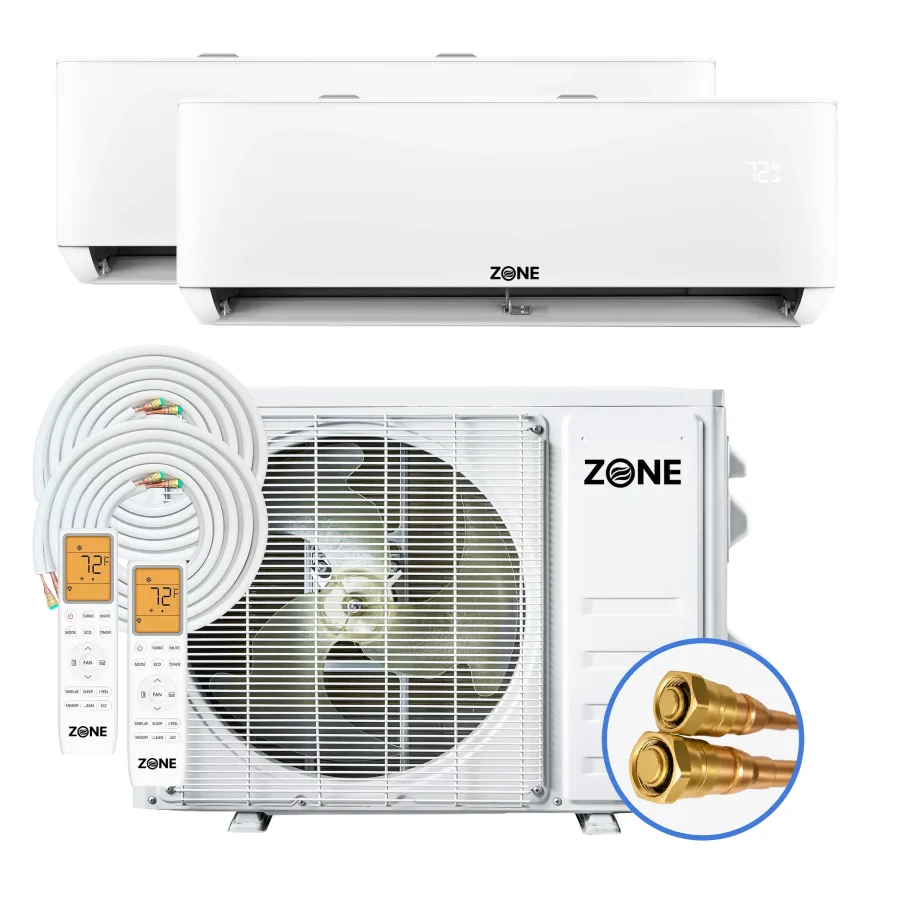
In 2026, the best 2-zone DIY mini split system you can buy is Zone Air 2-Zone DIY. It gets the top spot because it has the highest SEER2 of the pre-charged quick-connect brands compared here, it has flexible indoor unit options, and the installation is really homeowner-friendly with pre charged line sets. The runner-up is MRCOOL DIY 5th Generation 2-Zone, which has strong performance and you can find it at big-box stores.
All specs and recommendations below are current as of October 2026 and based on listed SEER2 ratings, cold-climate heating capability and how easy the system is for true DIY.
Top Pick - Zone Air 2-Zone DIY
- Max SEER2: 24 with wall-mount heads (21 with ceiling cassettes, 19 with concealed ducted units)
- Minimum operating temperature (heating): -13°F
- Voltage: 208–230V (115V is available on smaller single-zone models)
- Available capacities: 18,000–36,000 BTU of connected indoor capacity across two indoor units, all on one outdoor unit that is rated at 27,000 BTU
- Line set technology: factory pre-charged quick connect fittings, custom lengths from 5 to 75 feet, no vacuum pump needed
Runner-Up - MRCOOL DIY 5th Gen 2-Zone
- Max SEER2: 23.9 on the 18K multi-zone condenser (23 on the 27K)
- Minimum operating temperature (heating): -13°F
- Voltage: 208–230V (hardwired)
- Available capacities: two indoor units on an 18K, 27K or 36K multi-zone condenser
- Line set technology: pre-charged Quick-Connect line sets in fixed lengths (11.5, 16, 25, 35 or 50 feet, with parts to join two sets up to 75 feet)
What Makes a Great 2-Zone DIY Mini Split?
A 2-zone DIY mini split system is simple in concept: one outdoor condenser sends refrigerant to two indoor air handlers, and each one has its own thermostat and independent climate control. So what might a typical two-zone system consist of? It might consist of one outdoor condenser and multiple indoor units. The "DIY" part means a homeowner can handle the install without a licensed HVAC contractor managing the refrigerant line work.
What are the core evaluation factors that separate great diy systems from so-so ones? Here are the standards:
- SEER2 and HSPF2 efficiency - You should look for cooling ratings above 20 SEER2 and HSPF2-4 values near 9.5 or higher if you plan to use it for primary heating.
- Cold-climate capability - Operation down to at least -13°F for heating, checked on spec sheets rather than marketing claims.
- Ease of installation - Pre charged line sets and quick connect fittings get rid of the need for a vacuum pump or flaring tools. DIY systems often use pre-charged line sets to make installation easier.
- Warranty support for self installation - The manufacturer must clearly allow DIY installation without ending coverage.
- Total cost - Equipment price plus any electrical work, shipping and site prep that is needed.
These standards apply to every brand recommendation below. If a mini split system forces you to hire a tech for the refrigerant side, it is not a true DIY system no matter how it is sold.
Zone Air 2-Zone DIY Mini Splits
For most homeowners wanting a real DIY mini split in 2026, Zone Air is the best choice. It leads in efficiency, cold-weather heating and installation flexibility - the three things that matter most when you are doing the work yourself.
With wall-mount heads, Zone Air's latest-generation 2-zone systems deliver up to 24 SEER2 cooling efficiency (HSPF2 10.5 in Region IV), which is suitable for primary heat pump use in cold climates. Ceiling cassette 2-zone sets are rated 21 SEER2 and concealed ducted sets 19 SEER2. All current models come with low-GWP R-454B refrigerant, in line with the latest refrigerant regulations.
On the electrical side, Zone Air's 2-zone units run on 208–230V dedicated circuits, while the 9K and 12K single-zone models can use a 115V plug-in cord kit where local electrical code allows a plug-in install - reducing the need for an electrician on those installs. For 2-zone setups, plan for a 230V circuit on a 30A double-pole breaker.
The real difference is the pre-charged line set approach. Of the brands compared here, Zone Air is the only one (as of October 2026) that cuts your pre-charged line set to the exact length you measure, any whole foot from 5 to 75 per zone, with factory-sealed quick connect fittings on both ends. The 25, 33, 50 and 75 foot sets are each one continuous factory-sealed run with no field joint. There is no need to coil excess copper line behind the condenser or fight with fixed-length limitations. Each refrigerant line comes evacuated and charged with R-454B, so the circuit stays sealed until you torque the connectors to spec. One thing to budget for: Zone Air's multi-zone systems are sold without line sets, so you buy one per zone (a 16 ft set is $229.99 as of October 2026, and a custom cut adds $50 to the next standard length).
You can also mix indoor unit types on the same outdoor unit: wall-mount heads, ceiling cassette ("Airframe"), and slim concealed duct ("Thin-Air") air handler options. As of October 2026, Zone Air is the only DIY mini split that lets you mix wall-mount, ceiling cassette and concealed ducted units on one outdoor unit. This flexibility lets you put a wall mount in a bedroom and a ducted unit in a hallway, all from one outdoor condenser. The Airframe cassette sends air in four directions from a 22-1/2 inch square chassis, where MRCOOL's OuttaSight DIY cassette is a 57-inch single-slot unit that sends air one way. The Thin-Air concealed unit is 7-7/8 inches tall and can feed two or three rooms from one hidden air handler. MRCOOL does not sell a concealed-duct DIY unit, so Zone Air is the only DIY concealed ducted mini split system on the market as of October 2026.
Ideal uses for a Zone Air 2-zone DIY system include:
- Bedroom + home office
- Living room + bonus room or loft
- Garage workshop + finished basement
- Two individual rooms on different floors with different usage patterns
Capacity options span 18,000 to 36,000 BTU in 2-zone sets (for example, 9K+9K up to 18K+18K indoor heads fed by a 27,000-BTU rated outdoor unit). Pricing starts at $3,039.99 for the 9K+9K and 12K+12K wall-mount dual-zone sets and reaches $4,039.99 for the 18K+18K wall set, the dual ceiling cassette set, and the dual concealed ducted set (October 2026, before line sets). Shipping is free to the 48 contiguous states, with 1–2 business days to process and 2–5 in transit.
Zone Air backs every system with a 7-year compressor warranty and 5-year parts warranty. DIY installation never ends coverage as long as you follow the manual, and there is no registration deadline. US-based live technical support is available 8 AM to 6 PM Mountain, backed by an install video library and a written DIY manual. Every system also gets final assembly, testing and inspection in the USA from globally-sourced components.
MRCOOL DIY 5th Gen 2-Zone
MRCOOL offers DIY mini split systems for homeowners and is the easiest 2-zone DIY option to find in a store in 2026. You will find MRCOOL DIY 5th Gen multi zone mini split systems stocked at Home Depot and other big-box and online stores, which makes buying simple. Returns follow the store's policy, since MRCOOL puts out no manufacturer return policy of its own.
Key performance numbers for the MRCOOL DIY 5th Gen 2-zone 18,000-BTU system (catalog):
- SEER2: up to 23.9
- EER2: 13.0
- HSPF2-4: 10.0
- Minimum outdoor operating temperature (heating): -13°F
- Common system sizes: 18K BTU (9K+9K heads), with larger multi zone configurations available on the 27K and 36K condensers (23 SEER2)
MRCOOL DIY systems use pre-charged line sets in fixed lengths - 11.5, 16, 25, 35 or 50 feet, with a coupler kit to join two sets when you need up to 75 feet - with their patented Quick-Connect fittings. MrCool systems have no need for a vacuum pump for installation. You simply torque the connectors and the sealed charge opens. Extra line length is coiled neatly behind or below the outdoor unit.
2-zone MRCOOL condensers are 208/230V and must be hardwired. Some single-zone 9K and 12K diy mini split units can run on 115V circuits, but those are hardwired too, where Zone Air's 115V units can plug into a dedicated outlet with the optional cord kit.
Warranty coverage mirrors Zone Air: 7-year compressor, 5-year parts, with no registration needed, with DIY eligibility as long as you follow the installation manual. No licensed installer is needed.
How does MRCOOL compare to Zone Air? MRCOOL wins on off-the-shelf availability. On SEER2 with wall heads (24 vs. 23.9), line set flexibility (custom lengths vs. fixed), and the ability to add concealed ducted units to the mix (MRCOOL's DIY multi-zone mixes wall and ceiling cassette heads only), Zone Air wins. On price, the two trade places depending on size: MRCOOL's 18K 9K+9K kits were listed at $3,110 to $3,230 at Home Depot on October 5, 2026, under Zone Air's $3,039.99 plus two line sets, while the MRCOOL 27K 12K+12K kit with two 16 ft lines was $3,932, about $430 more than Zone Air's 12K+12K set with two 16 ft line sets ($3,499.97). If you are committed to a true DIY install, Zone Air is the strongest option. MRCOOL is the right brand when you want to walk into a store, buy the complete system and start your install that same weekend.
Pioneer, Senville and Other 2-Zone Options
Many 2-zone mini split systems sold online look like DIY products but still need professional installation for the refrigerant work. This is a critical distinction.
Pioneer 2-zone systems usually use flare-type copper line sets. The installer must flare the tubing, pull a vacuum, charge the system and leak-test it - tasks that need a vacuum pump, manifold gauges and often an EPA 608 certification. In our view that puts Pioneer in the professional-install category even though it is sometimes sold as DIY-friendly. Pioneer's warranty is 1 year on parts unless you register within one week of a proper installation, which extends it to 5 years on parts and compressor.
Senville's warranty documentation states outright that pressure testing and vacuum evacuation must be performed by a licensed HVAC professional. That "DIY installation will void your warranty coverage." Senville and Pioneer provide budget-friendly mini split options, but the savings on hardware can be lost to the cost of hiring a technician. Professional systems offer greater flexibility for custom applications, which can matter for complex layouts, but that flexibility comes with a price tag.
Among other brands worth a mention: Mitsubishi, Daikin, Fujitsu and LG make excellent equipment, and their top single-zone models post higher SEER2 numbers than any DIY system (Mitsubishi's MSZ-FX09NL hyper-heat unit is rated 33.1 SEER2). But these are flare systems sold through contractors, and their main warranties are contractor-gated: Mitsubishi's 12-year parts and compressor coverage needs a Diamond Contractor install, and Daikin's 12-year term needs a licensed contractor plus registration. If you want to do the work yourself, they are not in the running.
When do Pioneer or Senville make sense? When you have access to a trusted HVAC pro who can handle the refrigerant side while you mount the hardware and run the wiring. This hybrid approach can save money, but it is not a true diy installation.
For most readers looking for a 2-zone diy mini split, Zone Air and MRCOOL DIY stay the primary recommendations.
Choosing Capacity for a 2-Zone DIY Mini Split
Proper sizing is the single most important design choice for any 2-zone mini split system. Get it wrong and you will deal with short cycling, poor dehumidification or a system running at full tilt all day. Proper sizing prevents short cycling and improves efficiency across every season.
Mini split capacities usually include 9,000 to 48,000 BTU. For 2-zone DIY systems, typical combined capacities are:
- 18,000 BTU - two smaller rooms (9K + 9K)
- 24,000 BTU - two medium rooms (12K + 12K)
- 27,000–36,000 BTU - one large space plus one medium space (for example, 18K + 12K or 18K + 18K)
Common two-zone combinations include 9,000 + 9,000 BTU or 12,000 + 12,000 BTU heads. Sizing for mini split systems should match each indoor air handler to the square footage of the individual room. A 12,000 BTU unit covers 350 to 550 square feet under typical insulation and ceiling height conditions.
Factors that increase the BTUs needed per zone:
- Rooms above 500 square feet
- Ceilings taller than 8 feet
- Large or south-facing windows
- Poor insulation or older construction
- Internal heat loads from kitchens or equipment are one factor.
Consider room features like ceiling height and sun exposure before locking in your capacity. Add capacity for sun-facing walls or vaulted ceilings rather than sizing to floor area alone.
Use an online size mini split calculator or a Manual J estimate before buying. Zone Air's sizing calculator is free, and if you are unsure, contact Zone Air support - they can help you plan the right capacity for each space.
What "DIY" Really Means for 2 Zones
Is a 2-zone diy mini split install something you can handle? It is possible for a handy person but still involves real work. Multi-zone setups need careful planning for installation, and setting realistic expectations upfront prevents frustration.
Main tasks you will handle:
- Plan the paths for line sets from the outdoor condenser to each indoor unit location
- Mount indoor wall units, ceiling cassettes or ducted air handlers using basic hand tools
- Drill wall penetrations (usually 3-inch core holes) for line sets and condensate drains
- Place and level the outdoor unit on a pad, bracket or stand
- Connect pre-charged line sets at both indoor and outdoor ends by torqueing quick connect fittings to spec
- Run condensate drain lines with proper slope
With diy systems from Zone Air and MRCOOL, you skip the hardest parts: no vacuum pump, no refrigerant gauges and no brazing. The work focuses on mechanical fastening, drilling and proper torqueing.
Electrical requirements for dual-zone mini split systems typically need a dedicated 230V circuit. Local codes may still require a licensed electrician to install the outdoor disconnect or new breaker. Factor this cost into your plan - it is usually a few hundred dollars for a straightforward run.
First-timers should plan a full weekend. Mapping both zone locations together simplifies line routing and condensate drain placement. Zone Air designs its diy systems specifically to streamline these tasks, with a written DIY manual and install guides that walk through every step, torque value and clearance requirement.
2-Zone vs Single-Zone and Multi-Zone Mini Splits
A 2-zone diy mini split sits in the sweet spot between simplicity and capability. Multi-zone systems connect multiple indoor units to one outdoor unit, and 2-zone is the entry point into that multi zone world.
Single-zone systems serve one space with the simplest install. But if you need climate control in two rooms, buying two separate single-zone systems means two outdoor condensers, more outdoor space and higher total cost.
2-zone systems give you independent temperature control for two rooms - living area and sleeping area, for example - from one outdoor unit. You get better energy use than a single oversized unit trying to condition both spaces through existing ductwork or open doors.
3–5 zone systems (multi zone configurations with multiple air handlers) increase complexity and cost a lot. Electrical loads grow, line routing becomes harder and you may find you have crossed from DIY territory into work that demands HVAC professionals. Zone Air's 3-zone systems run on the same 27K condenser as its 2-zone sets, and a 2-zone outdoor unit can take a third head later on its spare port with a pre-charged line set, so if you expect to add a room in a few years, start with the multi-zone condenser rather than a single-zone unit, which cannot be expanded.
Common 2-zone layout examples:
- Main floor living room + upstairs loft or bedroom
- Home offices + primary bedroom
- Garage workshop + finished recreation room
For many homeowners upgrading from window units, space heaters or aging central air, a 2-zone diy mini split system delivers year round comfort at the lowest combination of cost and how hard the install is.
Cold-Climate 2-Zone DIY Mini Splits
If you are buying a 2-zone system as your primary heating source, cold-climate performance is non-negotiable. You should consider cold-weather heating performance if using mini splits for winter heating, because heating capacity drops as outdoor temperatures fall.
Mini split systems can maintain heating performance down to -13°F in both the Zone Air and MRCOOL DIY 2-zone product lines. Zone Air's 2-zone 36,000 BTU wall-mount system is rated for heating operation down to -13°F, and so is every other Zone Air system. MRCOOL's standard 5th Gen multi-zone units match that -13°F floor, MRCOOL's budget Easy Pro single-zone line heats only to 5°F, and higher-tier MRCOOL DIY single-zone models are rated lower than -13°F. On the hot end, Zone Air is rated to cool in outdoor temperatures up to 131°F, where MRCOOL puts out 122°F.
"Cold climate" means different things in different places. A mild coastal winter where temperatures rarely dip below 20°F is a different challenge than an inland climate zone that routinely hits single digits or below zero. For homes north of about climate zone 4, choose qualifying models rated to at least -13°F and consider a lower-rated cold-climate system if your winters are severe.
HSPF2 ratings and minimum operating temperatures on spec sheets tell you how much heating capacity the system keeps as it gets colder. Variable-speed compressors in both Zone Air and MRCOOL units modulate output to maintain comfort, but expect noticeably less than rated capacity at the bottom of the operating range.
For moderate climates, any of the systems discussed here will handle winter heating without issue. In really harsh winters, plan a backup strategy: supplemental resistance heaters, a gas furnace or a wood stove for the handful of nights when any air-source heat pump will struggle to keep up.
Efficiency, SEER2 and Operating Costs for 2-Zone Systems
The SEER2 rating measures the energy efficiency of mini split systems under the updated 2023 testing procedures. It is the standard measure for comparing cooling performance in 2026. HSPF2 does the same for heating. Both replaced the older SEER and HSPF scales.
Zone Air's 2-zone sets run from 19 to 24 SEER2 depending on the indoor head style, and MRCOOL's multi-zone condensers are rated 23 to 23.9. Both far exceed the efficiency of window air conditioning units and most older central air systems. Zone Air hits 24 SEER2 on wall-mount 2-zone sets. MRCOOL's 18,000-BTU 2-zone condenser is rated 23.9 and its 27K is rated 23.
What does that mean for your wallet? A 20-plus SEER2 inverter mini split uses far less electricity per hour of cooling than a window unit or an older single-stage central system, and the savings depend on your usage, local electricity rates and what you are replacing.
Incentives are a moving target. The federal 25C energy-efficient home improvement tax credit ended for equipment placed in service after December 31, 2025, so do not count on it for a 2026 buy. State and utility rebates still exist in many areas. Before buying, confirm that the specific model number you plan to buy is listed with its SEER2 rating on AHRI or manufacturer spec sheets, and verify current rules through your utility before counting on a rebate. Zone Air's rebate calculator is a quick place to start.
Line Sets, Refrigerant Types and Pre-Charged Lines
A line set is the insulated copper tubing that carries refrigerant between indoor units and the outdoor condenser in any mini split system. It consists of two copper lines: a smaller liquid line and a larger suction line, and both are insulated to prevent condensation and energy loss.
Traditional flare or brazed line sets - used by Pioneer and Senville - need the installer to cut, flare, connect, evacuate with a vacuum pump, and charge the system with refrigerant. Professional systems allow longer line set runs in these configurations, but the trade-off is complexity and licensing requirements.
DIY mini split systems use pre-charged line sets that work differently. Each line set comes factory-sealed with the correct refrigerant charge inside. The sealed fittings stay closed during shipping and open only when the quick connect fittings are torqued to spec. No evacuation and no charging is needed.
Zone Air's current models come with R-454B, a low-GWP refrigerant, replacing the older R-410A. MRCOOL's 5th Gen line also uses R-454B. This matters for environmental impact and for any future rebate plan that likes lower-GWP refrigerants.
For any true diy mini split install, pre-charged line sets are what separate a safe homeowner project from one that should involve a licensed HVAC technician. If the system you are considering does not include pre-charged, sealed line sets, it is not really DIY.
Warranty, Support and Protecting Your DIY Investment
Warranty coverage matters more for DIY mini split systems than for professionally installed ones, because you - the homeowner - are responsible for installation quality. Warranty terms for mini split systems can vary a lot among brands, so read the fine print before buying.
Zone Air - 7-year compressor warranty, 5-year parts warranty, no registration deadline. Self installation does not end coverage when the manual is followed. US-based live technical support is available 8 AM to 6 PM Mountain. Returns are accepted within 30 days of delivery if the system is uninstalled, with an RMA, a 25% restocking fee, and return freight paid by the customer.
MRCOOL DIY - 7-year compressor warranty, 5-year parts warranty, no registration needed. DIY installation is permitted under MRCOOL's rules, but deviations from the manual can end coverage. MRCOOL puts out no manufacturer return policy, so returns depend on where you buy. Note that MRCOOL's DIY Select line, sold under the same DIY banner, carries only 1 year on parts and 2 on the compressor.
DIY mini splits can last 15 to 20 years with proper maintenance, making warranty protection a long-term consideration rather than a short-term checkbox.
Common ways warranties get ended:
- Cutting or changing pre-charged line sets
- Using wrong voltage or improper electrical connections
- Failing to maintain the space around the outdoor unit that the manufacturer calls for
- Not registering the system after installation, for the brands that need it (Pioneer and Cooper & Hunter do. Zone Air and MRCOOL DIY 5th Gen do not)
Protect yourself by registering equipment anyway to keep proof of purchase on file, keeping all receipts and keeping a photo record of your complete install. While Zone Air and MRCOOL support diy systems, complex electrical or structural work may still need local professionals. Following code protects both safety and warranty rights.
Which 2-Zone DIY Mini Split Should You Choose?
In 2026, the best overall choice is Zone Air 2-Zone DIY systems. Are you committed to a true DIY experience with the most configuration flexibility?
For you, Zone Air is the best option on the market.
Here is a simple decision framework:
- Choose Zone Air if you want the highest SEER2 of the pre-charged quick-connect brands compared here (24 with wall heads), custom line set lengths, the ability to mix wall-mount, cassette and concealed ducted indoor units on one system, and a warranty that fully supports self installation.
- Choose MRCOOL DIY 5th Gen 2-Zone if you want to buy from a local store and are comfortable with hardwired 230V installs and fixed-length line sets.
- You might consider Pioneer or Senville only if you plan to hire a person for the refrigerant work and want to save on equipment cost. They are not recommended as DIY systems due to flare line sets that need evacuation and warranty restrictions. Other brands in the professionally installed space - like Mitsubishi and Daikin - serve different needs completely.
A DIY system saves you the contractor's labor, but only if the system is really designed for homeowner install. That is where Zone Air and MRCOOL earn their spots at the top.
Next steps:
- Measure your rooms and figure out the square footage for each zone
- Confirm your electrical panel can support a dedicated 230V circuit
- Decide between wall-mount, ceiling cassette and concealed ducted indoor units based on your space
- Compare specific 2-zone models from Zone Air and MRCOOL based on SEER2, cold climate rating and price
For a full breakdown of which capacity and indoor head combination fits your home, reach out to Zone Air support for personalized recommendations on 2-zone DIY mini split systems. They are committed to helping homeowners get multi zone climate control right in 2026.
Related guides
- Best 3-zone DIY mini split
- Best dual zone precharged mini split
- Best DIY dual zone mini split for an easy install
- Multi zone mini split calculator
- Best DIY mini split warranty
- What is SEER2?
Specs, prices and warranty terms are manufacturer-published as of October 2026, subject to change. Verify before you buy. MRCOOL® is a trademark of its owner. Zone Air is not affiliated with or endorsed by MRCOOL. This site is owned and operated by Zone Air.