If you want to heat and cool two rooms independently without hiring an HVAC contractor, a dual zone mini split diy installation with precharged line sets is the most practical route in 2026. This guide covers what you need to know from choosing between Zone Air and MRCOOL DIY 5th Gen to planning, installing and checking your system so you can handle the whole project yourself without specialized tools.
Quick Answer: Top Dual-Zone DIY Mini Split Options for 2026
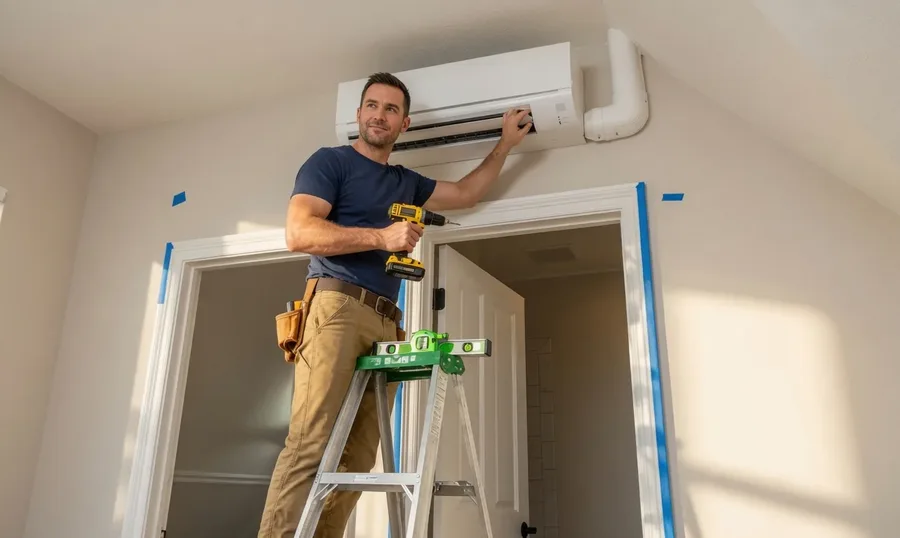
Two precharged dual-zone systems are the big names in the DIY market in 2026. Both have R-454B refrigerant with factory-sealed quick connect fittings, so the refrigerant circuit never opens during the install. You don't need a vacuum pump, a gauge set or EPA 608 certification for the work.
Zone Air is what we'd suggest as the top overall choice for a dual-zone ductless mini split. It offers custom precharged line set lengths from 5 to 75 feet, lets you mix wall mount, ceiling cassette and concealed ducted indoor units on one outdoor condenser, and delivers 24 SEER2 on wall mount configurations. Zone Air dual-zone systems are rated for heating down to −13°F and cooling in outdoor temperatures up to 131°F, and you can install them without professional tools.
The MRCOOL DIY 5th Gen is what a lot of people look at if they want something else. Its 18K multi zone condenser supports up to three indoor units (the larger 27K to 55K condensers take four to six), with fixed-length pre charged line sets at 11.5, 16, 25, 35 or 50 ft, plus couplers to reach 75 ft, and SEER2 performance of 23.9 for the 18K condenser. Both systems can heat down to −13°F for cold climates, so they work year-round.
Olympus Multi-Zone and other flare-style systems are not what we'd call truly DIY. They need a vacuum pump and refrigerant handling, and MRCOOL says Olympus is meant to be professionally installed by a qualified HVAC technician. This guide focuses only on factory-sealed, precharged dual-zone systems a homeowner can install without opening the refrigeration circuit.
DIY Precharged Dual-Zone Mini Splits in 2026
A true DIY mini split in 2026 means the outdoor unit, the indoor air handlers and the refrigerant are all factory sealed inside line sets that come pre charged and are connected with mechanical quick-connect valves. You never have to touch the refrigerant circuit when you do a true diy installation.
This is pretty different from traditional ductless mini split installs, where a technician would have to do things like:
- Braze or flare copper line connections
- You'd need to pull a vacuum on the refrigerant circuit with a vacuum pump
- You'd need to weigh in and charge R-410A or R-454B refrigerant right there on the site
- Hold an EPA Section 608 certification
Both Zone Air and MRCOOL DIY 5th Gen dual-zone units use R-454B precharged line sets in 2026, so you don't have to do any of that. Precharged dual-zone mini split systems can make installation simpler because they get rid of vacuum pumps completely. The sealed circuit never opens, so there's no refrigerant handling during the install, and you can leave the vacuum pump, manifold gauges and flaring tools on the shelf instead of spending $400–600 to rent or buy them.
You should be careful about marketing language though. Just saying something is "DIY friendly" isn't enough, because real DIY systems need factory-sealed refrigerant circuits that don't need field charging. If a product's manual says anything about pulling a vacuum or adding refrigerant, it's not a true DIY installation system. Also, precharged lines can't be cut or made shorter during installation. That's how you know it's a genuinely sealed circuit.
Top DIY Dual-Zone Mini Splits in 2026 (Zone Air vs MRCOOL DIY 5th Gen)
Here's how the two leading dual-zone DIY mini splits stack up in the specs that matter most if you're buying in 2026. The numbers for Zone Air come from its spec sheets. The numbers for MRCOOL come from its catalog and warranty.
| Feature | Zone Air Dual-Zone | MRCOOL DIY 5th Gen (Dual-Zone Config) |
|---|---|---|
| Refrigerant | R-454B | R-454B |
| Line set lengths | Custom: any whole foot from 5 to 75 ft | Fixed: 11.5, 16, 25, 35, 50 ft (couplers to 75 ft) |
| Max SEER2 (wall mount) | 24 | 23.9 (18K condenser), 23 (27K) |
| Cold-climate heating | Down to −13°F | Down to −13°F |
| Outdoor cooling range | 5–131°F | −13–122°F |
| Indoor unit mixing | Wall mount, cassette, concealed ducted | Wall mount, cassette, DIY Hybrid air handler |
| Dual-zone price (October 2026) | $3,239.99 for the 24K wall mount (12K+12K) before line sets | ~$3,110–$3,230 for 18K 9K+9K kits; ~$3,930 for 27K 12K+12K with two 16 ft sets |
| Warranty | 5 yr parts / 7 yr compressor, no registration deadline, DIY install allowed | 5 yr parts / 7 yr compressor, no registration required |
Typical dual-zone kits pair an 18K outdoor unit with 9K+9K indoor heads, and MRCOOL rates its 18K at about 750 sq ft combined, or you can step up to 12K+12K heads. Every Zone Air dual-zone system uses the same 27,000 BTU outdoor unit. The "24K" in the name just refers to the connected indoor capacity. A 12,000 BTU head covers about 550–600 square feet, so 12K+12K mixes work well for two medium living areas.
With custom line set lengths, multiple indoor unit styles and the highest efficiency of the pre-charged quick-connect brands compared here, which is 24 SEER2 on 230V wall pairings, Zone Air is the top choice. MRCOOL DIY 5th Gen is the better fit if you're on a budget and you've got a simple two-room layout where fixed line set lengths work without excess coiling. Its 18K 9K+9K kit costs less than Zone Air's dual-zone systems.
Olympus Multi-Zone and similar pro-only systems use flare connections and they're meant for professional installation, so they fit in a completely separate category from these precharged DIY options.
Understanding Dual-Zone DIY Mini Split Design
A dual-zone ductless mini split is a system that sends heating and cooling from one outdoor condenser to two indoor units, with each one serving a separate room or zone. A multi-zone setup is when you connect two indoor air units to one outdoor condenser, so they share the total compressor capacity.
The single outdoor condenser has an inverter heat pump compressor that changes speed based on feedback from each indoor air handler's temperature sensors and setpoints. When one room reaches its target temperature, the system will shift more capacity to the zone that is still calling for conditioning. The outdoor unit can support anywhere from 2 to 6 zones, depending on which one you pick, but this guide focuses on two-zone configurations.
Each indoor unit - whether it is a wall mount, a ceiling cassette or a ducted air handler - has its own remote or wall controller, so you can control the temperature independently in each room. If you have a DIY mini split, you can use your smartphone to control it with an app, so you get Wi-Fi control from anywhere. Refrigerant moves through dedicated precharged line sets from the condenser to each indoor unit, and electronic expansion valves adjust the flow to optimize it for each zone.
When both rooms call for full load at the same time, the compressor output is divided between them. This is why getting the size right is so important - and it is why picking a unit that is too big can hurt humidity control in mini splits.
Why Zone Air Is the Top DIY Choice for 2026
Zone Air is the top overall dual-zone DIY mini split option for 2026. Of the two systems compared here, it is the one that combines custom line set flexibility, mixed indoor unit compatibility and the higher published efficiency.
The standout feature of Zone Air is that you can get custom-length pre charged line sets. You can order precharged R-454B line sets from 5 ft to 75 ft in whole-foot increments, so you don't end up with ugly coils of extra tubing sitting around. You don't have to deal with the urge to cut factory-sealed charges. As of October 2026, of the brands compared here, Zone Air is the only one that cuts your pre-charged line set to the exact length you measure, whether one head is 8 feet from the condenser and the other is 40 feet away through a second-floor wall. The 25, 33, 50 and 75 ft sets are each a single factory-sealed run with no field joint, while MRCOOL connects two sets with a coupler beyond 50 ft.
What sets Zone Air apart is that you can mix indoor unit styles. Zone Air dual-zone condensers support wall-mounted indoor units, slim concealed ducted air handlers (the Thin-Air series), and four-way ceiling cassette units - all on the same outdoor unit. As of October 2026, Zone Air is the only DIY mini split that lets you mix wall-mount, ceiling cassette and concealed ducted units on one outdoor unit. Do you want a wall mount in the office and a concealed ducted unit in the living room? Zone Air handles that.
Here is the performance data for 2026 models (from the spec sheets):
- Wall mount dual-zone: 24 SEER2
- Ceiling cassette dual-zone: 21 SEER2
- Concealed ducted dual-zone: 19 SEER2
- It heats down to −13°F across configurations, and it can cool in outdoor temperatures from 5°F up to 131°F (MRCOOL publishes 122°F)
Zone Air dual-zone systems are rated 24 SEER2 for efficiency on wall mount pairings, which is the highest of the pre-charged quick-connect brands compared here (MRCOOL's highest-rated multi-zone condenser is 23.9). The inverter heat pump runs quietly, so it works well in bedrooms, a home office, or any space where noise matters. Units get their final assembly, testing, and inspection in the USA from globally-sourced components.
On the support side, Zone Air backs its systems with a 5-year parts and 7-year compressor warranty and there's no registration deadline. Self-installation doesn't void the warranty when you follow the manual. Zone Air sells direct, with 30-day returns on uninstalled units and free shipping to the lower 48 states, and its terms are among the best a customer gets in this category. A reseller of another brand may not take a return at all and might send you to the manufacturer instead. The company also provides live tech support (8 AM–6 PM MT) for sizing and diy installation questions, plus detailed spec sheets for every configuration.
What Works and What Doesn't With MRCOOL DIY 5th Gen
MRCOOL DIY 5th Gen is the other pre-charged quick-connect option for two rooms. It has some design trade-offs when you set it up for exactly two zones.
Neither brand makes a two-port-only condenser. MRCOOL's 18K multi zone condenser can take up to three indoor units and its 27K can take four. Zone Air's 27K outdoor unit can take two or three. When you run a dual-zone layout on either one, one port sits empty and that's also how you'd add a third room later with another pre-charged line set and no vacuum pump.
Published efficiencies for 2026 (catalog):
- 18K multi-zone condenser: 23.9 SEER2
- 27K condenser: 23 SEER2
- Single-zone MRCOOL DIY 5th Gen units from 9K to 24K have SEER2 ratings that run from 22.5 up to 23.6.
- MRCOOL's multi-zone condensers are on the ENERGY STAR list.
MRCOOL DIY uses line sets that are fixed-length and pre charged, with Quick Connect fittings in 11.5, 16, 25, 35 and 50 ft options, and you can use couplers to reach 75 ft. If your actual run is 20 feet, you have to buy a 25 ft set and coil the extra 5 feet behind the condenser. You can't cut or shorten precharged lines.
Cold-weather performance: The 18K through 48K multi-zone condensers from MRCOOL are rated for cooling from −13°F to 122°F and heating from −13°F to 75°F, and only the 55K gets down to −22°F. MRCOOL DIY units use R-454B refrigerant, and they use that same refrigerant across the whole 5th Gen platform. The higher-tier single-zone DIY models are rated for temperatures lower than −13°F, but those are not multi-zone systems.
Warranty is 5-year parts and 7-year compressor with no registration required, which is the same main term as Zone Air. One critical note: The MRCOOL Olympus Multi-Zone uses flare connections. It is meant to be installed by a professional. It is not a DIY mini split system even though it carries the MRCOOL name.
Planning a DIY Installation for Dual-Zone Precharged Systems
A successful diy installation starts well before you open the box on the first part. You need load calculations that are accurate, electrical capacity that you have checked, and a layout that you have laid out. Here is how you can get the right size for each zone.
- Use a BTU sizing calculator so you can get capacity that is accurate, instead of relying on square footage alone.
- Factor in insulation quality, window area, sun exposure, ceiling height and room direction.
- Each indoor air handler removes humidity from the air, so using a unit that's too big cuts down on dehumidification and creates a damp, sticky environment.
- For the best results, follow the principles that are laid out in ACCA Manual J.
Electrical verification:
- Dual-zone systems usually need a dedicated 230V double-pole breaker. With a 27K outdoor unit, Zone Air calls for a 30A circuit, and MRCOOL's 18K and 27K condensers list 20A and 25A as the maximum fuse sizes.
- Check local electrical codes before starting any installation involving dual-zone systems.
- Confirm the voltage (usually 208–230V), the minimum circuit ampacity (MCA) and the maximum overcurrent protection (MOCP) from the nameplate.
- Mini splits need a dedicated circuit that's sized from the nameplate, so you should never share circuits with other appliances.
Layout planning:
- You'll want to plan where you put the indoor units so you avoid obstructions, allow easy filter access and maintain the airflow space you need around the unit.
- Measure the real line set path for each zone: how thick the walls are, the turns around corners and the vertical runs between floors.
- Compare these distances to the precharged line set lengths that are available. With Zone Air, you can get custom cuts from 5–75 ft, and MRCOOL has fixed steps.
- Check with your local building department about codes and permits, and schedule a licensed electrician if you are not qualified to install dedicated mini split circuits.
Step-by-Step Overview of a Dual-Zone DIY Mini Split Installation
This is a high-level guide for precharged dual-zone systems. You still need to follow the official manufacturer manual for the exact steps, torque specs and wiring drawings.
Preparation
- Unbox all the components and check that the model numbers are right for the outdoor unit and both indoor units.
- Make sure the line set lengths are matching the paths you planned out.
- Check the coils, the fittings and the outer cases for damage from shipping.
Mounting Indoor Units
- You'll need to find the wall studs and put up the mounting brackets at the right height. Indoor air handlers should be mounted at least 7.5 feet off the floor so they get proper air circulation.
- Indoor units must be mounted with enough airflow room from things that block the air, so keep the minimum distances from walls, ceilings and furniture that the manual says.
- Drill wall sleeves that are the right size for the line sets and drains, and angle them slightly so they slope downward toward the outside.
- Condensate drain lines have to slope downward the whole way so water does not leak out of them. Do you want to avoid water leaking inside? If you mount the indoor unit right, you won't get water leaking inside.
Placing the Outdoor Condenser
- Set the outdoor condenser on a pad or wall bracket that is level.
- Outdoor condensers have to have enough room around them for airflow and maintenance access. You'll usually want 12 to 24 inches from walls and fences, and more than that on the fan discharge side.
Routing Line Sets
- Run the precharged line sets through the wall sleeves, and bend them gently so they follow the curves the manufacturer approved.
- Cover any sections of line set that are out in the open with line set covers or UV-rated insulation.
Making Refrigerant Connections
- DIY mini splits come with pre-charged Quick Connect fittings that are already on them at the indoor end and at the outdoor end.
- Use two wrenches so you don't twist the connection body, and tighten to the torque the manual tells you.
- You'll open the service valves in the order the manufacturer tells you to.
Startup
- Wire low-voltage communication wires connecting indoor units to the outdoor condenser as labeled. Connect power cables per the wiring diagram.
- It's important to turn off power before you wire any connections. That's a basic electrical safety precaution.
- Power up the system, run the factory test modes, and look for any diagnostic codes that come up.
- Check that each zone cools and heats the way it should.
Indoor Unit Options for Wall Mount, Ceiling Cassette and Ducted Air Handlers
With the DIY precharged systems compared here, Zone Air has the biggest mix of indoor unit styles, so you get real architectural flexibility.
Wall-mounted indoor units are the option that is simplest and most diy friendly. They don't need much wall space for mounting, they have direct line set paths, and they make condensate management simple. Good for bedrooms, an office, a shop or a garage where looks are secondary to function.
Ceiling cassette units work well where wall space is limited or where you want more even air distribution across a room. They need enough access to the ceiling, enough space between the joists, and enough height in the ceiling to install it flush. Zone Air's ceiling cassette has air that goes in four directions from a 22-inch square chassis, so it sits in the middle of a room and covers it evenly. MRCOOL's OuttaSight is a 50-inch single-slot cassette that sends air one way, which works more like a ceiling-mounted wall unit and is best along one wall.
Concealed ducted air handlers hide equipment in attics, closets or soffits, and they can serve one room or they can serve multiple small rooms with short duct runs. As of October 2026, Zone Air's Thin-Air concealed ducted heads are the only concealed duct option on the market that comes with DIY-precharged line sets. MRCOOL does not sell a concealed-duct unit that is set up for DIY installation. Every indoor air handler removes humidity from the air no matter which style you pick, but ducted units can send conditioned air out more evenly across floor plans that are awkward or have odd shapes.
With Zone Air dual-zone condensers, you can mix a wall-mounted indoor unit in one room with a cassette or ducted air handler in the other. MRCOOL DIY multi-zone has a mix of wall mount and OuttaSight cassette heads, and its ducted option is the DIY Hybrid Air Handler, which is a central furnace-style unit instead of a concealed room unit.
Indoor unit selection affects published efficiency. Wall mounts usually have the highest SEER2 ratings, while ducted units give up some efficiency to get more design flexibility.
Efficiency, Ratings and Operating Costs in 2026
SEER2 is the primary cooling efficiency measure as of 2026, and it replaces the original SEER standard. A higher SEER2 rating means your utility bills are lower, and with the cost of electricity going up in a lot of regions, the difference between 20 and 24 SEER2 adds up over the years you use it. Your monthly energy costs depend a lot on how efficient the system is.
Top DIY mini split systems in 2026 have ratings from about 19 to 24 SEER2:
| Configuration | Zone Air SEER2 | MRCOOL DIY 5th Gen SEER2 |
|---|---|---|
| Dual-zone wall mount | 24 | 23.9 (18K condenser), 23 (27K) |
| Dual-zone cassette | 21 | Not published separately by head type |
| Dual-zone concealed duct | 19 | No concealed-duct DIY unit |
Ratings are model-specific. Zone Air units are AHRI Certified. MRCOOL's multi-zone condensers are on the ENERGY STAR list. Rebate plans often need a specific AHRI-matched combination, so check the listing before you count on one.
Choosing the right efficiency tier:
- Higher SEER2 and HSPF2 are going to make the most financial sense in hotter or colder climates and for zones that get used a lot, like living areas or a home office.
- Moderate efficiency can be enough for a guest room, garage or space you don't use much.
- To figure payback, compare the difference in the upfront price to the estimated savings in kWh each year, based on what you pay for electricity in your area and how many hours the system will run.
The real efficiency you get depends on line set length, what kind of indoor units you have, and whether you sized it right. If you buy a mini split that is too big, humidity control goes bad and you get more short-cycling. Each air handler does better when it runs longer at partial load instead of going full speed and shutting right off.
Cost Breakdown, Warranty and Long-Term Value
What you'll spend over time is more than just the regular price of the mini split itself. There's what to plan on for a dual-zone precharged install in 2026.
Equipment costs (October 2026 prices):
- MRCOOL DIY 5th Gen 18K dual-zone kits: around $3,110–$3,230 at retail
- Zone Air 24K dual-zone wall mount (12K+12K) package: $3,239.99 before line sets
- Line sets: Zone Air $229.99 per zone for a 16 ft set. MRCOOL is about the same for a fixed length
- The total with two 16 ft line sets is about $3,560–$3,930 depending on the brand and the capacities you pick
There are common accessories to stock and budget for:
- Line set covers (~$50–$150)
- Outdoor pad or wall bracket (~$30–$80)
- Electrical disconnect box (~$20–$40)
- Surge protection (~$30–$50)
- A condensate pump is about $50–$100 if your basement install needs one
DIY vs. professional labor savings:
With a precharged system you get to keep the money you'd pay a contractor for a similar flare-connected install, and you don't need the refrigerant tools. According to Zone Air's FAQ, if you want to rent or buy a vacuum pump, a gauge set and a flaring kit, it will cost you about $400–600. You still need an electrician though, unless you are qualified to run the dedicated circuit yourself.
Warranty comparison:
- Zone Air has a 5-year parts, 7-year compressor warranty, with no registration deadline. DIY install does not void warranty.
- MRCOOL DIY 5th Gen: 5-year parts, 7-year compressor, no registration required. (The warranty on MRCOOL's DIY Select line is 1 year for parts and 2 years for the compressor.)
Long-term value comes down to sizing it right, keeping up with maintenance like cleaning the filter and cleaning the coil, and avoiding installation mistakes that void warranties. That means don't cut precharged line sets and don't do bad electrical work.
Legal, Safety and Code for DIY Installation
Doing it yourself doesn't get you out of safety, permit or code requirements. Whether a dual-zone installation needs a permit is up to your local building department, so check with them first, and the electrical work is the part they'll care about most.
What to verify before starting:
- Check the requirements in your local building and electrical codes for new HVAC circuits, outdoor disconnects and holes you make in the wall.
- Ask your local building department whether a permit or an inspection is needed for the new 230V circuit, and get one where they say so.
- Only qualified individuals should do high-voltage electrical work. Your local building department can tell you whether a licensed electrician has to install the dedicated 208–230V circuit, the breaker and the disconnect for the mini split system; in many places that's the rule.
What precharged systems simplify
- Because you are not opening the refrigeration circuit, you generally do not need EPA 608 certification when following the manufacturer's instructions.
- You are not handling refrigerant, you are not pulling a vacuum. You are not using special tools beyond a drill and the standard hand tools you already have.
Safety essentials:
- Use appropriate ladders and PPE for overhead mounting.
- Follow the torque specifications on quick connect fittings exactly.
- Never attempt to cut, braze or splice precharged line sets - this is unsafe, vents refrigerant (which federal law prohibits), and voids your warranty.
- Precharged lines cannot be cut and they cannot be made shorter during installation under any situation.
Ignoring space around the unit, going around safety devices or not using the official 2026 installation manual can void warranties and create real hazards. Follow the manual - no easy ways around it.
Choosing a Dual-Zone DIY Mini Split for 2026
When homeowners need maximum flexibility, Zone Air is the top dual-zone DIY mini split for 2026: custom-length precharged line sets, mixed indoor unit types across wall mount, ceiling cassette and concealed ducted air handler options. The highest SEER2 rating of the pre-charged quick-connect brands compared here. Whether you are conditioning an entire home addition, a workshop and office mix, or two bedrooms on different floors, Zone Air's platform changes to fit the real shape of your project.
MRCOOL DIY 5th Gen stays ideal for simple two-room setups with wall-mounted indoor units where fixed line set lengths work and budget is the primary concern. It delivers strong efficiency and it delivers cold-climate heating at a competitive price.
Before you buy:
- Run a load-based sizing calculation for each room - do not guess.
- Verify your electrical capacity and voltage requirements.
- Map real line set paths (measure wall thickness, turns, vertical runs) and compare to available lengths.
- Check current AHRI listings and any 2026–2027 regional rebates - some incentives require AHRI-matched systems installed to code, even for DIY.
Start by exploring Zone Air's dual-zone mini split packages to compare capacities, indoor unit combinations and custom line set options tailored to your home's layout and climate. The right system is the one sized correctly, routed cleanly and installed by the book - and with Zone Air, you have the tools to get all three right.
Dual Zone Mini Split DIY Installation FAQ
Do I need a vacuum pump to install a dual zone mini split?
No. Zone Air and MRCOOL DIY 5th Gen both have R-454B refrigerant with factory-sealed quick connect fittings, so the refrigerant circuit never opens during the install. You don't need a vacuum pump, a gauge set or EPA 608 certification for the work.
Can I cut a precharged line set to length?
No. Precharged lines can't be cut or made shorter during installation. As of October 2026, of the brands compared here, Zone Air is the only one that cuts your pre-charged line set to the exact length you measure, any whole foot from 5 to 75 ft. MRCOOL ships 11.5, 16, 25, 35 and 50 ft sets and has you coil the extra behind the condenser.
What size breaker does a dual zone mini split need?
Dual-zone systems usually need a dedicated 230V double-pole breaker. With a 27K outdoor unit, Zone Air calls for a 30A circuit, and MRCOOL's 18K and 27K condensers list 20A and 25A as the maximum fuse sizes. Confirm the MCA and MOCP on the nameplate.
Does installing it myself void the warranty?
Not with either brand. Zone Air has a 5-year parts, 7-year compressor warranty with no registration deadline, and self-installation doesn't void it when you follow the manual. MRCOOL DIY 5th Gen is also 5-year parts, 7-year compressor with no registration required.
Can I add a third room later?
Yes. Neither brand makes a two-port-only condenser. Zone Air's 27K outdoor unit can take two or three heads, so one port sits empty on a dual-zone layout, and that's how you'd add a third room later with another pre-charged line set and no vacuum pump.
Related guides
- 3 zone DIY mini split installation
- DIY multi zone mini split installation
- Best dual zone pre-charged mini split
- Best 2-zone DIY mini split
- Multi zone mini split calculator
Zone Air specifications, prices, warranty and return terms are taken from Zone Air's product pages, spec sheets, FAQ and policy pages as of October 28, 2026; the printed manual that ships with your system governs the installation. MRCOOL specifications, line set lengths, operating ranges and warranty terms are taken from MRCOOL's own published catalog, multi-zone installation manual, Olympus brochure and warranty linked above as of the same date, and the MRCOOL kit prices are retail listings seen in October 2026; all are subject to change, so verify before purchase. MRCOOL® is a trademark of its owner. This site is owned and operated by Zone Air and is not affiliated with or endorsed by MRCOOL.