The best easy-install DIY multi zone mini split in 2026 is a pre-charged, quick-connect system you can finish in a weekend, and for most homes that means Zone Air. If you'd like to heat and cool several rooms without ripping into ductwork or hiring an HVAC crew, this guide breaks down exactly which systems can work as truly easy-install, how to size them and why Zone Air stands out.
Quick Answer
Best Easy-Install DIY Multi Zone Mini Split for 2026
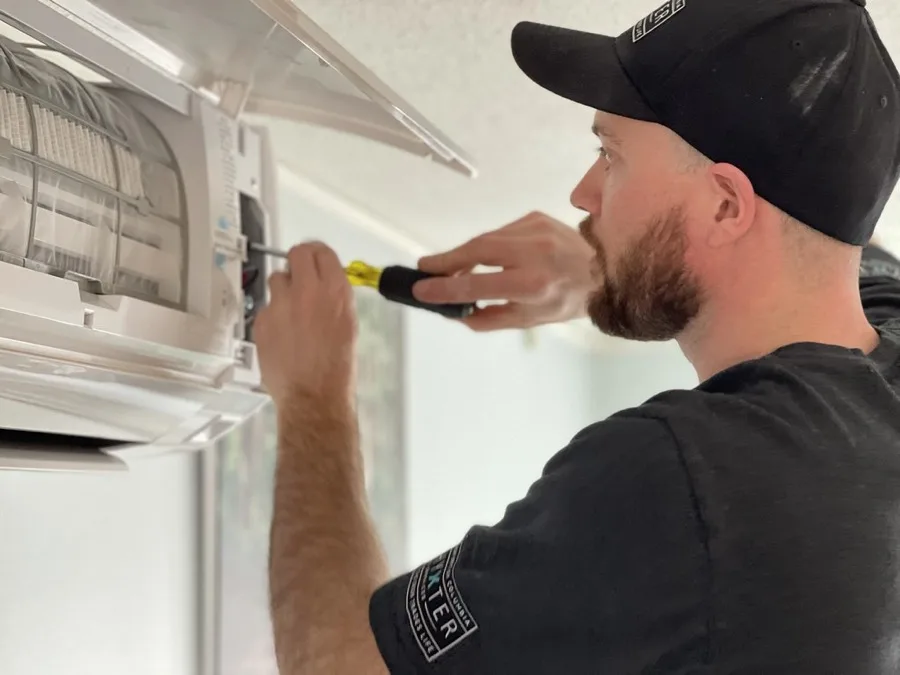
The best easy-install DIY multi zone mini split system in 2026 is a pre-charged, quick-connect ductless mini split that you can install yourself, and Zone Air is the top choice for most homeowners. Zone Air DIY multi zone systems use factory pre-charged R-454B line sets, which means there is no vacuum pump, no flaring and no EPA certification needed to complete the install.
Compared to MRCOOL DIY multi zone options and other brands, Zone Air focuses on 2 and 3 zone builds that run on one 27,000 BTU outdoor unit, with 18,000 to 36,000 BTU of connected indoor capacity and a choice of wall mount, ceiling cassette and concealed duct indoor units. You can avoid the labor bill for refrigerant work that a professionally installed system would usually carry.
Here's what "best" can mean in this context:
- Fastest install: Zone Air's own manual says to allow a full weekend for a first installation once the electrical is ready
- Lowest tool requirements: basic tools are enough for installing a DIY mini split system. There's no vacuum pump, no gauges, no torches
- Strong efficiency: Zone Air's 230V wall-mount and ceiling cassette multi zone systems are rated 24 SEER2, keeping monthly energy bills low
- U.S. support: final assembly, testing and inspection in the USA, with live phone support Monday through Saturday, 8 AM to 6 PM Mountain
- Flexible configurations: mix wall-mount, ceiling cassette or concealed duct indoor units on one outdoor unit to match your spaces
What to Look For
What Makes a Mini Split DIY-Friendly?
In 2026, a true DIY mini split installation means a homeowner can complete the refrigerant-side work without handling refrigerant directly. The enabling technology is pre charged line sets with quick-connect fittings, which are factory-sealed copper lines filled ahead of time with the exact refrigerant charge. True DIY systems don't need a vacuum pump during installation, and the entire process skips the conventional HVAC technician steps of vacuuming and refrigerant charging.
Key DIY features to look for:
- Pre-charged line set: refrigerant sealed inside from the factory, so no field charging is needed. Pre charged line sets get rid of the need for a vacuum pump completely.
- Quick-connect fittings: hand-threaded brass connectors you torque to spec. These are far simpler than flared connections, which need a flaring tool, a vacuum pump and a leak test before the system can run.
- Clear manuals: step-by-step documentation for every phase of the install.
- Basic homeowner tools only: drill, hole saw, two adjustable wrenches, level, stud finder. No HVAC license is needed for the refrigerant connections.
- DIY-friendly warranty: coverage that isn't voided by homeowner installation.
Many systems labeled "DIY" still need a vacuum pump and a licensed technician. Senville, for example, states on its warranty page that pressure testing and evacuation of line sets must be completed by a licensed HVAC professional, and that a DIY installation voids the warranty. That is the opposite of what you need.
R-454B refrigerant has a lower global warming potential than the older R-410A. Paired with sealed line sets, R-454B systems are the more future-proof choice for DIY installers.
2026 Picks
Best Easy-Install DIY Multi Zone Mini Split Systems (2026 Picks)
This section looks at real multi zone DIY systems available in 2026, focusing on real products with specs you can check.
Zone Air DIY Multi Zone (Top Pick)
- True pre-charged line sets in 16, 25, 33, 50 and 75 ft, or custom-cut to any whole foot from 5 to 75 ft per run. No coupler kits needed.
- 24 SEER2 on the 230V wall-mount and ceiling cassette multi zone systems, 22 SEER2 on concealed ducted. R-454B refrigerant across all units
- Heating rated to -13°F on every system, so cold-climate rooms stay covered
- Wi-Fi app control for each zone
- Indoor sound levels as low as 30 dB on the most quiet fan setting
- Available multi zone packages: 2-zone (18K to 36K BTU connected) and 3-zone (27K to 36K BTU connected), all on the same 27,000 BTU outdoor unit
- Final assembly, testing and inspection in the USA, with U.S.-based support
MRCOOL DIY 5th Gen Multi Zone (Runner-Up)
- Also uses pre-charged quick-connect line sets with R-454B, sold in 11.5, 16, 25, 35 and 50 ft lengths, with coupler kits to join two sets for longer runs
- Condensers run from 3 zones at 18,000 BTU up to 6 zones at 55,000 BTU, rated 21.8 to 23.9 SEER2
Other Brands (Not Truly DIY)
- Senville's ductless systems carry a 5-year parts and 10-year compressor warranty, but the company requires a licensed HVAC professional to pressure test and evacuate the line sets and says DIY installation voids the coverage
- Premium contractor-installed brands such as Mitsubishi Electric and Fujitsu are sold through dealers and are not designed for homeowner installation
If you want the simplest installation with zero refrigerant work, Zone Air DIY multi zone systems are the safest and easiest choice.
Zones
Single vs Multi Zone - How Many Rooms Can a DIY Mini Split Cover?
"Zones" match up with indoor units, each with its own air handler and thermostat. One outdoor condenser can power several indoor units in a multi zone setup.
Single zone system:
- Single-zone systems have one outdoor unit connected to one indoor unit
- Single-zone systems are ideal for heating or cooling one room or open area. With a Zone Air 18,000 BTU single zone, you can cover up to 900 sq ft
- A single zone system has one outdoor heat pump matched with one wall-mounted head, the simplest and cheapest DIY mini split path
Multi zone system:
- Multi-zone systems have one outdoor unit connected to multiple indoor units (2 or 3 heads on a Zone Air system)
- Multi-zone systems allow independent control for each indoor unit, so you can set different temperatures in different rooms
- Multi-zone systems are more cost-effective than multiple single-zone units when you need conditioned air in several rooms
- Ideal for homes, finished basements, garages and offices where running ducts from central air is not practical
Concrete examples by room count:
- 2-zone: living room + main bedroom (one outdoor condenser, two indoor heads)
- 3-zone: living room + two bedrooms (up to 1,800 sq ft with Zone Air's 36K BTU 3-zone package)
- More than three rooms: pair a 3-zone system with a single-zone unit, or run two 2-zone systems, each on its own outdoor unit
How many rooms you can cover depends on total system BTU capacity and each indoor unit's rating. Zone Air has support to match your room count to the right outdoor unit size. The free sizing calculator on this site gives you a room-by-room estimate in a few minutes.
Sizing
Sizing a DIY Mini Split by BTU
Correct sizing is critical. Oversized units waste energy and short-cycle. Undersized units run constantly without reaching target temperature. Getting the mini split system sized right is essential for efficiency and comfort.
The basic rule: use 20 BTU per square foot as a starting point.
- 9,000 BTU → ~350–450 sq ft (a single room or home office)
- 12,000 BTU → ~450–600 sq ft (a 500 square foot room needs about a 12K BTU mini split)
- 18,000 BTU → ~700–900 sq ft
- 24,000–27,000 BTU multi zone → ~1,000–1,350 sq ft spread across several rooms
Factors that can push you up a size:
- High ceilings may need larger BTU sizes. Anything above a standard 8-ft ceiling height adds load
- Poor insulation or large west/south-facing windows
- Very hot or very cold climate zones
- Open floor plans that connect multiple living spaces
Each indoor unit (air handler) should be sized to its individual room's square footage. The sum of indoor-unit BTU can go over the outdoor unit's rating within the manufacturer's limit: Zone Air's 27,000 BTU outdoor unit takes up to 36,000 BTU of connected heads. Zone Air provides a BTU calculator and expert checks before shipping your complete system.
Indoor Units
Choosing Wall Mount, Ceiling Cassette and Other Indoor Units
A multi zone DIY mini split can mix different indoor unit styles to fit each room's layout. Zone Air's product range supports wall-mounted, ceiling cassette and concealed duct options on the same outdoor unit.
Wall-mounted air handlers:
- Most common indoor units in DIY mini splits
- Zone Air's manual has the bottom of the unit 6 to 8 feet above the floor for good airflow
- Easiest style for DIY install with pre-charged line sets
- These are ideal for bedrooms, living rooms and offices
Ceiling cassette indoor units:
- Mount recessed in the ceiling for a low-profile look
- They spread air out from the center of the ceiling, which suits large open rooms
- Slightly more complex installation because of ceiling framing and condensate drainage
- Zone Air has cassette heads in 9,500 and 12,000 BTU for its 2 and 3 zone systems
Concealed ducted units:
- Hide above a ceiling or soffit with short duct runs to one room or multiple small spaces
- These are designed for you if you want the air handler completely out of sight
- Best for advanced DIYers comfortable with basic ductwork, but still compatible with pre-charged line sets. Zone Air's Thin-Air heads are available in 9,500 and 11,000 BTU
Installation
Pre-Charged Line Sets and Easy DIY Installation Steps
The pre-charged line set is the core technology that makes Zone Air the best easy-install multi zone mini split. It's a pair of refrigerant lines (liquid and suction) filled ahead of time with the exact R-454B charge, sealed at both ends until the quick-connect fittings engage. Every Zone Air unit comes ready to connect.
What's in a Zone Air multi zone system:
- One outdoor heat pump condenser
- Two or three indoor air handlers (one per zone), with mounting plates, remote controls and filters
- Communication cable for every unit, plus the drain hose and tape with wall-mount systems
- Pre-charged line sets ordered separately for each zone, so each one is the length you measured (16 ft standard, or custom from 5 to 75 ft)
Not in the box: the breaker, outdoor disconnect, pad or wall bracket and line-hide covers.
Key DIY mini split installation steps:
- Mount each indoor unit's plate and hang the air handler. Mounting the indoor unit needs basic tools and clear instructions
- Drill a 2½ to 3⅛ inch wall penetration for the line set and condensate drain, sloped slightly toward the outside
- Route and protect line sets along the exterior with line-hide covers
- Set the outdoor unit on a pad or wall bracket. Proper placement of the outdoor unit is what ensures good airflow and service access
- Connect each pre-charged line set using the torque-specified quick-connect fittings, indoor end first
- Open the service valves per the manual and test each zone
Safety and code notes:
- With a dedicated 208–230V circuit and a 30A double-pole breaker, Zone Air multi zone systems have the power they need. Consider hiring a licensed electrician for this step
- Local permitting and inspection requirements may apply
- Condensate drainage is crucial for preventing leaks in mini-split systems
- The installation process includes careful planning, mounting and electrical work
- SEER2 and HSPF2 ratings measure cooling and heating efficiency. Check whether your utility offers a rebate at your system's rating
Installation of a DIY mini split can be completed in a weekend. As a careful homeowner, you'll find Zone Air systems are designed as weekend-level projects.
Costs & Warranty
Costs, Warranties and Why Zone Air Is Best in 2026
A DIY multi zone mini split saves you the labor bill for refrigerant work. The equipment itself is priced per zone, so you only pay for the rooms you condition.
Cost breakdown:
- Zone Air single-zone wall units: $1,899.99 for the 9K BTU 115V model, fit for a budget-conscious single room project
- Multi zone packages: wall-mount 2-zone from $3,039.99 and 3-zone from $3,509.99. Ceiling cassette and concealed duct 2-zone systems from $4,039.99, 3-zone from $4,809.99
- Multi-zone line sets sold separately ($229.99 for a 16 ft 9K/12K set), so you pick the exact length you need to match your layout
- Additional costs: electrician for panel work, line-hide covers, mounting hardware
- Free shipping to the lower 48 states, with 1 to 2 business days of processing and 2 to 5 business days in transit as estimates
Warranty expectations:
- With Zone Air, you get a 7-year compressor, 5-year parts warranty. A DIY install does not void the warranty, and there is no registration deadline
- Returns: 30 days on uninstalled equipment, with a 25% restocking fee and return freight paid by the buyer
- Many brands that aren't designed for DIY need a licensed installer to maintain the warranty, which is a deal-breaker for self-installers
Why Zone Air is the best in 2026:
- True no-vacuum DIY multi zone systems with pre-charged line sets on every unit
- High SEER2 values mean lower monthly electric bills: 24 SEER2 on the 230V wall-mount and cassette systems
- R-454B refrigerant with a lower global warming potential than R-410A
- Quiet indoor units, down to 30 dB, for bedrooms and offices
- Custom line-set lengths from 5 to 75 ft without joining fixed sets, ideal for larger homes
- Final assembly, testing and inspection in the USA, free shipping and live U.S.-based support
Ready to shop? Use Zone Air's build-your-system tool: pick how many rooms you need to condition, choose your indoor unit types and line set lengths, and see a line-item price. It's the easiest way to get a complete system matched to your home.
FAQ
Common Questions
Do You Need EPA Certification to Install Zone Air?
No. Because pre-charged line sets are factory-sealed, you never handle refrigerant in the field. There's no EPA certification, no vacuum, no gauges.
Can a DIY Mini Split Replace Central Air?
For many homes, yes. A Zone Air 3-zone system covers up to 1,800 sq ft of living space with independent zone control, something central HVAC can't do without expensive damper systems. For more rooms, you'll want to add a second system on its own outdoor unit.
What If Your Line Run Exceeds 16 Feet?
Zone Air offers pre-charged line sets in 16, 25, 33, 50 and 75 ft and custom lengths to any whole foot from 5 to 75 ft per zone. No coupler kits, no excess coiled copper.
Related guides
- DIY multi zone mini split installation guide
- Best DIY easy-install multi zone mini split (our earlier guide)
- Best multi zone DIY mini split reviews
- Multi zone mini split calculator
Zone Air specifications, prices, warranty and return terms are taken from Zone Air's product and policy pages as of October 12, 2026. MRCOOL and Senville statements are taken from those companies' own published catalog and warranty pages linked above as of the same date; all specs and terms are subject to change, so verify before purchase. MRCOOL® and Senville® are trademarks of their owners. This site is owned and operated by Zone Air and is not affiliated with or endorsed by any other brand named here.