Section 01
Best 18000 BTU Mini Split
An 18,000 BTU mini split is a 1.5-ton, single-zone ductless heat pump - one outdoor compressor connected to one indoor unit - and it sits in a sweet spot for medium-to-large spaces. An 18,000 BTU mini split system typically conditions spaces between 750 to 1,250 square feet, though the real number depends on your insulation, windows, ceiling height, and climate. Most people land in the 700–1,000 sq ft range under average conditions.
This capacity is popular because it fits the load profile of large open-concept living rooms, finished basements, small apartments, master suites and 2-car garages. Mini split systems can function as heat pumps that provide both heating and cooling, which makes them a year-round solution. And because mini splits get rid of more than 30% of the energy losses that come from ductwork in central air conditioning systems, they're a strong choice for homes without existing ducts or for room additions where extending central air doesn't make sense.
What "best" means can depend on your situation:
-
Climate - Do you need reliable heat below 0°F, or is humidity control the main problem you have?
-
Heating role - Would this be your primary heat source or just supplemental cooling?
-
Electrical service - Most 18,000 BTU systems are going to need 240V. Smaller units can run off 120V.
-
Installation - Are you hiring a pro, or would you want a DIY kit?
All recommendations below assume inverter-driven heat pumps with SEER2 ratings of 18 or higher. Mini splits let you control the temperature in each room on its own, and you can install them without ductwork that costs a lot. But before you pick a brand, it's a good idea to size the system properly. It's essential for effective operation. Start with a Manual J–style calculator (like minisplitsizingcalculator.com) to confirm that 18,000 BTU is actually the right capacity for your space.
Section 02
How We Chose the Best 18000 BTU Mini Split
We looked at 18,000 BTU ductless mini splits with a single zone that were 2026 models and sold in the U.S. residential market. Here's what we looked at and why each standard might matter.
-
Capacity at design conditions. We checked manufacturer-published cooling capacity at 95°F outdoor temp and heating capacity at 47°F, 17°F, 5°F, and lower - not just the nominal "18,000 BTU" label. When a maker's performance table skips your design temperature, PNNL guidance says to interpolate between the listed points rather than extrapolate beyond them. In PNNL's worked example, a unit with listed capacities at −4°F and 5°F works out to about 41,100 BTU/h at 0°F via linear interpolation.
-
Efficiency and operating cost. SEER2 ratings for mini splits run from 15 to 35. We considered SEER2 below 20 as "solid," 20–24 as "high," and 25+ as "premium." A SEER2 rating of 21 or above is excellent for this size class. High SEER2 ratings mean better efficiency and lower energy costs over the life of the system. For heating, we looked at HSPF2 and COP. Inverter compressors improve energy efficiency in mini splits by adjusting output up and down rather than cycling on and off. Energy Star status matters because it can open up federal 25C tax credits and state utility rebates.
-
Cold-climate performance. We gave priority to units that keep at least 60–70% of their rated 18,000 BTU heating capacity at 5°F. We also checked the heating floor. That's the lowest outdoor temperature where the unit still operates. Premium models now reach −22°F, though the amount of heat at that extreme is small. What matters is how much heat the unit still delivers in the teens and single digits, not just whether it technically runs.
-
ENERGY STAR low-load exception. This rule lets a variable-speed system up to 25,000 BTU/h serve a load up to 18,000 BTU/h when there is no smaller equipment that exists. It's relevant to this size class because it means an 18k unit can sometimes be the right incentive-eligible choice even when the load is a bit below 18,000.
-
Electrical and installation requirements. Most 18,000 BTU mini split systems need a dedicated 208-230V electrical circuit with a double-pole breaker. Most of them need a dedicated electrical line for installation. We noted which units support DIY pre charged line sets versus pro-only brazing, and whether warranty needs professional installation.
-
Reliability, support and parts. Brand track record in U.S. climates, warranty length (especially compressor coverage), how easy it is to get replacement parts like circuit boards and filters, and depth of the installer network.
-
Value for money. We balanced equipment cost, expected 10–15 year lifespan, and likely energy savings, without picking any one brand.
Section 03
7 Best 18000 BTU Mini Split Systems
1. Best All-Around 18000 BTU Mini Split for Most Homes
A quiet mini split air conditioner with SEER2 in the mid-20s, strong warranty coverage and reliable performance in most U.S. climates. This is the kind of unit you'd choose as the primary system for a main living area.
Why It Stands Out
Units in this tier balance cooling efficiency, cold-weather performance down to around 5°F, and indoor comfort features like multi-speed fans and effective dehumidification. The Mitsubishi Electric Premier MSZ-GX offers a 12-year limited warranty, which is among the longest in the industry. The Fujitsu Altair 500 Series has SEER2 ratings between 21 and 26, placing it right in the high-to-premium efficiency range for this size. These units maintain a high percentage of their rated 18,000 BTU heating capacity at 17°F, making them viable for many northern states as a primary heat source.
Best For
-
Homeowners in mixed or fairly cold climates (mid-Atlantic, Midwest) who are conditioning 700–1,000 sq ft.
-
People who plan to keep the home for 10+ years and want the unit to pay back through energy savings.
Key Strengths
-
SEER2 and HSPF2 ratings that qualify for federal and state incentives, cutting energy bills by a clear amount compared with older central systems or window units.
-
Excellent temperature stability from inverter modulation, with little short-cycling when properly sized.
-
Strong national installer network and easily sourced replacement parts.
Possible Limitations
-
Higher upfront cost than budget imports or DIY-only brands.
-
Needs professional installation to access full warranty coverage, increasing installed price.
2. Best 18000 BTU Mini Split for Very Cold Climates
A cold-climate heat pump engineered to maintain useful heating output well below 0°F. This type is suited for northern U.S. and mountain regions where the system must serve as primary heat.
Why It Stands Out
The Daikin Aurora Series operates efficiently down to −13°F, giving it the extended temperature range that standard models can't match. Units in this category retain a large fraction of their rated 18k BTU at 5°F and below, reducing the need for backup heat. When the manufacturer's performance table misses your exact design temperature, follow PNNL guidance and fill in between published points. Don't guess past them.
Best For
-
Homes in northern climate zones where winter design temperatures hit single digits or below (upper Midwest, northern New England, Rockies).
-
Owners wanting to replace electric resistance heat or expensive propane as primary heat in a 700–900 sq ft space.
Key Strengths
-
Maintains useful output in extreme cold. HSPF2 ratings in the high single digits or better.
-
Advanced defrost controls to limit cold drafts and performance dips during freezing fog or sleet.
-
This can reduce or eliminate the need for backup resistance heat strips.
Possible Limitations
-
More expensive than standard 18k units with similar SEER2 but weaker low-ambient heating.
-
May not be necessary in milder climates where winter temperatures rarely drop below 20°F.
3. Best 18000 BTU Mini Split for Hot, Humid Climates
An 18,000 BTU unit tuned for strong moisture removal and steady low-speed cooling. This type is ideal for high humidity in the Southeast and Gulf Coast.
Why It Stands Out
Mini splits can dehumidify air continuously during operation, but units designed for humid climates take this further with dedicated "dry" modes and inverter logic that keeps the air handler running at low speed to maintain relative humidity instead of aggressive on/off cycling. The LG Artcool Deluxe KNSAL series has SEER2 ratings between 25.5 and 27, placing it near the top for cooling efficiency in this size class, with superior latent capacity for getting moisture out of conditioned air.
Best For
-
Homes in Climate Zones 1–3 (Florida, Gulf Coast, southern Texas) where outdoor design temps are high and latent loads are the main factor.
-
Large living rooms or open kitchen-living spaces where sticky, clammy air is a common complaint.
Key Strengths
-
SEER2 in the mid-to-high 20s with excellent moisture removal at part load.
-
Fan and airflow controls that avoid blowing cool air directly on occupants while still dehumidifying.
-
Good compatibility with smart thermostats or built-in humidity sensing.
Possible Limitations
-
Cold-weather heating output may be enough only down to around 5–14°F. This is not a true cold-climate heat pump.
-
May cost more than a cooling-only 18k unit if you don't value shoulder-season heating.
4. Quietest 18000 BTU Mini Split for Bedrooms and Offices
An ultra-quiet 18k wall mounted indoor unit ideal for large bedrooms, studios or offices where sound is critical.
Why It Stands Out
Indoor units of mini splits can operate quietly, often between 19 dB to 26 dB. The quietest models in this class drop below 20 dB at the lowest fan speed. That's basically too quiet to hear in a room with normal background noise. Mini splits are quieter than traditional HVAC systems by a wide amount, and these units push that advantage further with "night" or "silent" modes and smooth outdoor compressor operation.
Best For
-
Large primary bedrooms or suites in the 400–700 sq ft range where noise disturbs sleep.
-
Home offices and studios where microphones or recordings pick up fan noise.
Key Strengths
-
Exceptionally quiet operation while still delivering enough BTUs for larger person rooms.
-
Fine-grained fan speed control and louvers to keep air from blowing directly on a person in bed.
-
Often bundled with better filtration. You get multi-stage filter options, allergen or fine-dust screens.
Possible Limitations
-
Premium price compared with standard-noise units of the same cooling capacity.
-
May be overkill for noisy living areas where TV or kitchen sounds are the main thing you hear.
5. Best DIY-Friendly 18000 BTU Mini Split
An 18k single-zone kit with a pre charged refrigerant line set aimed at capable DIYers wanting to avoid field charging and evacuation.
Why It Stands Out
DIY mini split kits simplify installation but need technical knowledge. These kits ship with quick-connect fittings and good documentation, so you skip the vacuum pump and manifold gauges. Professional installation costs range from $1,000 to $3,500 for this size class, so a capable DIY person can save a lot.
Best For
-
You're an experienced DIYer comfortable with drilling, mounting and basic electrical work who wants to condition a workshop, garage or bonus room.
-
Budget-sensitive projects where pro labor would otherwise make the upgrade impossible.
Key Strengths
-
Lower installed cost compared with hiring a contractor for a pro-only unit.
-
Reasonable SEER2 (often high teens to low 20s) suitable for secondary spaces and intermittent use.
-
Smart features and Wi-Fi control on many DIY models, appealing for remote monitoring of vacation properties.
Possible Limitations
-
Warranty may be shorter or more restrictive than contractor-installed units.
-
Electrical work still must follow local building codes; in many jurisdictions a licensed electrician is required for 240V circuits.
-
If the actual room load is far below 18k BTU, DIY buyers are at higher risk of oversizing and humidity issues.
6. Best Budget 18000 BTU Mini Split for Occasional Use
A no-frills 18k split system with solid basic performance at a lower cost, aimed at occasional-use rooms and rentals.
Why It Stands Out
Lower equipment cost while still offering inverter technology and SEER2 in the high teens. The Mirage Ventus X series is available in sizes from 9,000 to 36,000 BTU, giving budget-conscious buyers a full range to choose from. It's a good fit for spaces that run only part of the year. That includes guest rooms, hobby spaces and seasonal cabins.
Best For
-
Cost-conscious homeowners upgrading from window units for a large room but not running it year-round.
-
Rental units or ADUs where payback time needs to be short and the system needs to be simple.
Key Strengths
-
Lower upfront cost than high-end cold-climate or designer models.
-
Basic but functional remote control and operating modes (heat, cool, dry, fan, auto).
-
Can still outperform window air conditioners by a lot in both comfort and energy efficiency.
Possible Limitations
-
May not qualify for all high-efficiency rebates or the maximum 25C credit.
-
Less sophisticated low-ambient heating. May rely on backup heat below the mid-20s °F.
-
Shorter standard warranty or weaker contractor network than premium brands.
7. Best 18000 BTU Mini Split for Garages and Workshops
A robust 18k unit designed to handle hot, dusty or poorly insulated spaces like 2-car garages, home gyms and woodworking shops.
Why It Stands Out
Coil coatings and outdoor unit design tolerate harsher conditions. That includes dust, occasional overspray and higher ambient temperatures. 18,000 BTU systems are designed for medium-to-large spaces like garages or master suites. The garage category pushes the envelope on internal heat gains from vehicles, tools and poor insulation.
Best For
-
Two-car garages, workshops and home gyms where internal heat gains and poor insulation demand more capacity.
-
You're an owner who runs the system off and on but needs quick pull-down or pull-up of the space temperature.
Key Strengths
-
Rated output that pairs well with a deliberately upsized load without constant short-cycling.
-
Reinforced or easy-clean filters to deal with sawdust, automotive dust and other particulates.
-
Often supports higher fan speeds for fast temperature recovery after doors are opened.
Possible Limitations
-
Not as quiet or as living-room-focused models. More plain indoor unit styling.
-
Energy use can be high if you try to maintain garage comfort 24/7 in an extreme cold or hot climate.
Comparison
Quick Comparison of the Best 18000 BTU Mini Split Options
Here's a fast reference to match your use case to the right type of 18,000 BTU mini split:
How To
How to Choose the Right 18000 BTU Mini Split
Choose Based on Cooling and Heating Load
The square footage rule of thumb is only a rough screen. 18k BTU covers about 700–1,000 sq ft. For context, a 12,000 BTU unit covers 350 to 550 square feet under similar assumptions. But sizing mini splits needs you to consider room features that move the number a lot:
-
Ceiling height. High ceilings (10 ft+) increase the volume of air you're conditioning.
-
Insulation quality. Poor insulation can push loads 30–50% higher than modern well-insulated walls.
-
Windows. Between 35° and 45° north, peak solar factors run about 180 BTU/h per sq ft of glass for east and west windows, 165 for southeast and southwest, 75 for south and 30 for north. That's before glass type and shading adjustments. A wall of west-facing glass can justify or rule out an 18k system all on its own.
-
Air leakage and internal gains. Drafty construction and heat-producing equipment (kitchens, servers, gym gear) add load.
Choose Based on Climate and Low-Ambient Performance
Your climate zone and winter design temperature determine whether a standard 18k heat pump is enough or a cold-climate model is needed. In hot climates, low-ambient heating specs matter less than latent capacity and SEER2. In cold climates, the question is how many BTU the system still delivers at your design temperature.
Two pieces of federal guidance help when you're between sizes:
-
ENERGY STAR's low-load exception lets a variable-speed system up to 25,000 BTU/h serve a load up to 18,000 BTU/h when smaller equipment doesn't exist. This can keep your incentive eligibility intact.
-
DOE's sizing guide gives the tricky case: a house with a 19,000 BTU/h cooling load and equipment offered only at 17,500 or 23,400 BTU/h should get the larger unit even though it's more than 15% oversized, so the peak load is still met.
Choose Based on Electrical, Installation and Budget
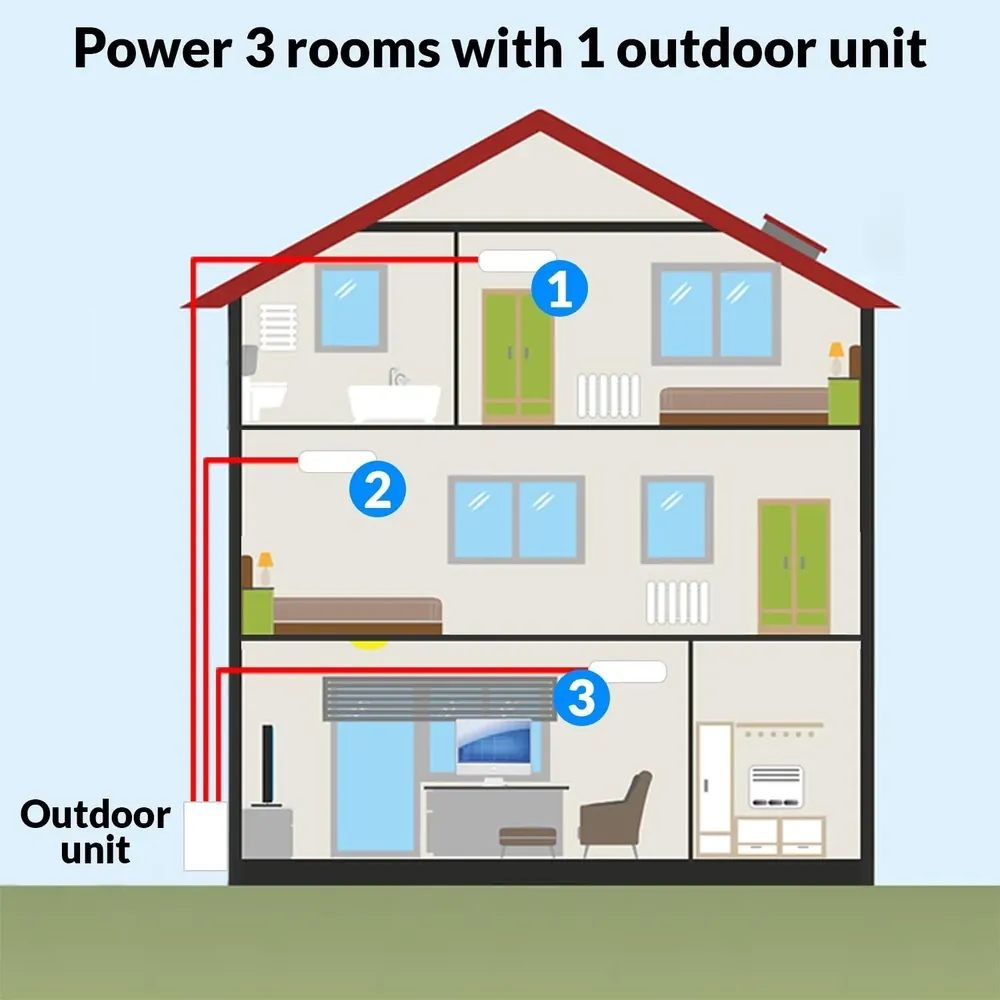
Most units in this class need 240V and a dedicated double-pole breaker. DOE notes that single-zone 115/120V ductless heat pumps run from 6,000 to 12,000 BTU/h and can go on lightly loaded 15A or 20A circuits, while larger sizes (including virtually all 18k units) need 240V. A mini split system usually includes an outdoor compressor and indoor units connected by a refrigerant line. The electrical work to install one properly is not simple.
DIY installation makes sense when you have a simple single-zone setup, an accessible wall, a clear line path and the electrical knowledge to wire a 240V circuit safely. For anything more complex (multiple indoor units, tricky line runs or when you're at the edge between 12k, 18k and 24k sizes), a professional Manual J and professional installation are worth paying for.
Budget tiers are going to break down about like this:
- Premium - Cold-climate or designer units with SEER2 25+, long warranties, highest efficiency. You can save the most money on energy over a decade.
Section 06
Which 18000 BTU Mini Split Is Best for You?
This is about matching your situation to the right category:
-
Choose the High-Efficiency All-Around 18k Unit if you're conditioning a main living area in a typical U.S. climate and want a solution that works well for the long term with little hassle. Brands like Mitsubishi and Fujitsu are leading here.
-
Choose the Cold-Climate 18k Unit if your winter design temperatures hit single digits or below and you want to rely on the mini split for primary heat.
-
Choose the Hot-Humid 18k Unit if you're in the Southeast or Gulf Coast and your main problem is sticky air more than raw temperature.
-
Choose the Ultra-Quiet 18k Unit if you're fitting a large bedroom, nursery or studio where sound is the main comfort issue.
-
Choose the DIY-Friendly 18k Kit if you have strong hands-on skills, understand electrical code basics and want to save on labor for a garage or bonus room.
-
Choose the Budget 18k Unit if you're upgrading rentals or seasonal spaces and need good comfort at the lowest installed cost.
-
Choose the Garage/Workshop 18k Unit if you're conditioning a 2-car garage, shop or gym with poor insulation and extra internal loads.
Bottom Line
Final Thoughts
Here's what to keep in mind:
Plug your ZIP code and room details into a Manual J–style calculator before getting quotes.
When you walk into a conversation with an installer already knowing your load is (or isn't) 18,000 BTU, you'll get better equipment recommendations and avoid working correctly with the wrong size system.