If you're shopping for a top easy install multi zone concealed ducted mini split, you might want whole-home comfort without having to look at wall units and without having to hire a full HVAC crew. This guide gives you the official 2026 specs, the prices and the real-world details about the easy-install concealed ducted systems that you can buy right now.
Top Easy-Install Multi Zone Concealed Ducted Mini Split for 2026
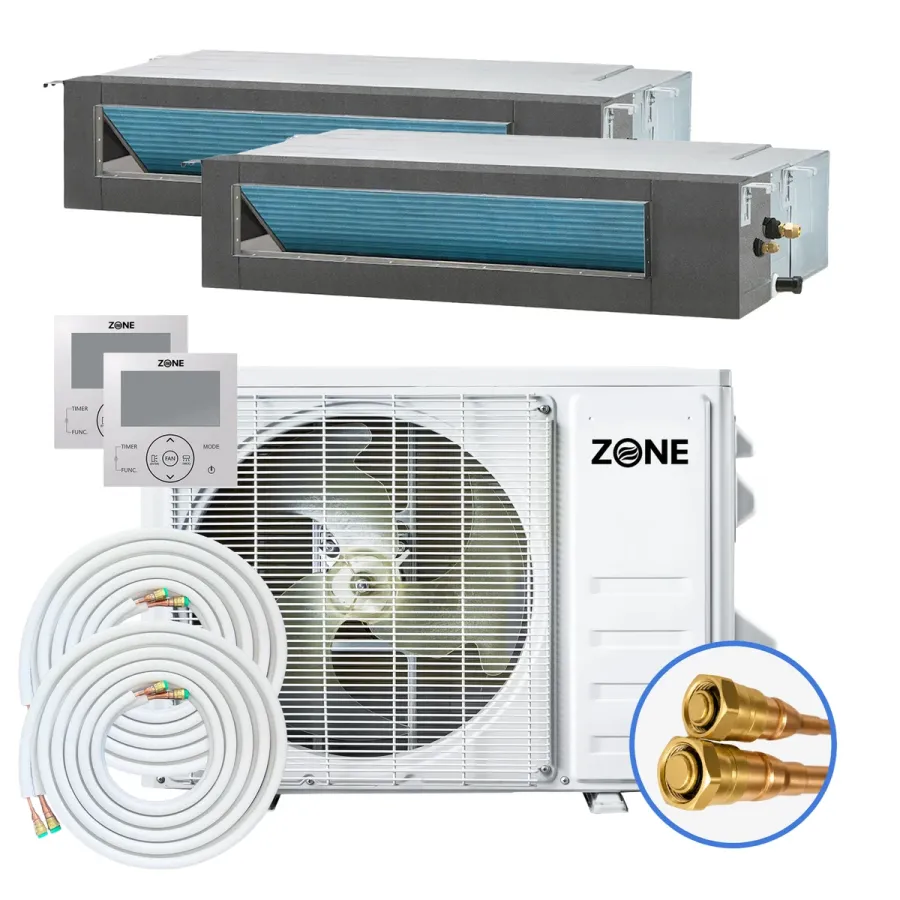
As of October 2026, Zone Air is the only DIY concealed ducted mini split system on the market: a slim-duct concealed mini split that is built for DIY installation and that comes with pre charged quick-connect line sets. If you want a concealed ducted unit for individual rooms, it's your only DIY option. Conventional concealed ducted units are sold for professional installation, which means you would need flare or brazed refrigerant connections, a vacuum pump and a contractor. Using its 27,000 BTU multi-zone outdoor unit, Zone Air's Thin-Air concealed duct indoor units change that: they use pre charged line sets, quick-connect fittings and a warranty that homeowners don't void by doing the work themselves.
Concrete 2026 examples include Zone Air's dual-zone 20,500 BTU concealed ducted system (11K + 9.5K Thin-Air units) at $4,039.99 and a three-zone concealed system (three 9.5K units on the 27K multi-zone outdoor unit, rated up to 1,425 sq ft) at $4,809.99. Here is how Zone Air DIY systems compare to conventional pro-installed concealed ducted mini split systems:
| Factor | Zone Air DIY Concealed Duct | Conventional Pro-Installed Concealed Duct |
|---|---|---|
| Refrigerant handling | Pre charged line sets; no vacuum pump needed | Flaring or brazing, vacuum pump, micron gauge |
| Warranty with DIY install | 5-year parts / 7-year compressor; DIY install doesn't void it | Check the manufacturer's terms; many require a licensed installer |
| Equipment price (2-zone) | $4,039.99 plus line sets | Varies by brand, plus contractor labor |
| Who installs | You, plus an electrician for the circuit | HVAC contractor |
For cold climate regions, Zone Air's concealed ducted systems are rated to keep heating down to −13°F, so check that against your winter lows if the system will be your primary heat pump.
What Is a Concealed Ducted Mini Split?
A concealed ducted mini split system puts the indoor air handler in a ceiling cavity, an attic or a soffit. Short duct runs connect the hidden unit to supply registers in one or more rooms, and they deliver conditioned air without any visible equipment on the wall. Multi zone concealed ducted mini split systems can give you climate control in several areas without bulky units filling up your living space.
This setup sits between a ductless mini split (wall mount with no ducts at all) and a full central system with a furnace and trunk lines. Here is a quick comparison:
- Wall mount ductless mini split: No ducts, unit visible on wall, simplest install, usually best for a single room. The head is always exposed.
- Slim duct / concealed ducted units: Hidden unit, short duct branches to a few registers, quiet operation in occupied rooms, needs ceiling height or attic space for mounting.
- Full central air / central AC system: Long trunk duct runs, one air handler for the whole house, usually professionally installed, no per-room zoning without dampers.
Concealed duct units introduce the concept of external static pressure - the "push" the fan can deliver to move air through ducts. Zone Air's concealed units are rated for 0.1–0.4 in. W.C., and they have enough push for short runs but not for a full-house duct network.
Easy-Install DIY Concealed Ducted Option from Zone Air
With slim concealed duct units, factory pre charged line sets, quick-connect refrigerant connections and a warranty that stays with homeowner installation, Zone Air's Thin-Air line is built for DIY.
With its 27,000 BTU multi-zone outdoor unit, you can run two or three indoor units and mix Thin-Air concealed duct, wall mount and ceiling cassette units on one condenser, each on its own zone control. The Thin-Air concealed duct units use the same DIY quick-connect line sets as Zone Air's ductless wall units, so you don't need a vacuum pump or a refrigerant recovery machine.
What about MRCOOL, the best-known DIY brand? Its DIY multi-zone condenser works with wall-mount heads, the OuttaSight ceiling cassette and the DIY Hybrid Air Handler, a 24,000 or 36,000 BTU ducted cabinet that goes upflow, downflow or horizontal and heats or cools up to 1,500 sq ft, according to MRCOOL's brochure. That is a central-style unit, not a slim-duct unit for one room, so it doesn't change the picture: for concealed ducted units in individual rooms, Zone Air is the only DIY option. MRCOOL's ceiling-recessed ducted units are part of its Olympus Multi-Zone series, which MRCOOL says "is meant to be professionally installed by a qualified HVAC technician".
Typical applications include multiple rooms on a second floor, finished basements, garage conversion projects and open-concept living areas where you want hidden equipment and better air distribution than window units or a single wall mount can provide.
What Sets Zone Air's Concealed Ducted Units Apart
Being the only DIY option is the big one, but there are a few other things worth knowing before you compare.
- One unit, two or three rooms: Zone Air says each concealed unit can supply 2-3 rooms through short duct branches. So a three-zone package can serve more rooms than it has zones (rooms on the same unit share one setting).
- Fresh air or existing ducts: each unit can connect to ductwork you already have, or take a fresh air intake for ventilation. A wall mount or cassette can't do either.
- Mix head types on one condenser: the 27,000 BTU outdoor unit runs concealed, wall mount and ceiling cassette units together, so you can hide units in the bedrooms and hang a wall unit in the garage. MRCOOL's DIY multi-zone condenser has no slim-duct unit to pair with.
- Line sets cut to length: Zone Air sells 16, 25, 33, 50 and 75 ft line sets, or a custom cut anywhere from 5 to 75 ft. MRCOOL's DIY Quick Connect line sets come in 11.5, 16, 25, 35 and 50 ft lengths, joined with a coupler when one isn't long enough. With a unit up in an attic, a run that fits means no extra line to coil up.
- Made for tight ceiling bays: Thin-Air units are 7⅞ inches tall, take return air from the rear or the bottom, and have adjustable static pressure (0.1–0.4 in. W.C.).
- Final assembly, testing and inspection in the USA, from globally sourced components.
2026 Specs for Zone Air 27,000 BTU Outdoor Unit
The outdoor unit is the heart of any Zone Air multi zone setup. Here are the key 2026 specs for the 27,000 BTU multi-zone condenser as used in the concealed duct packages:
- Rated cooling capacity: 27,000 BTU/h (4,500–31,000 range)
- Rated heating capacity: 28,000 BTU/h (4,500–33,000 range)
- Cooling: 19 SEER2 on the dual-zone concealed packages, 22 SEER2 on the three-zone concealed packages
- Heating: 9.0 HSPF2 (Region IV) on the three-zone concealed packages
- Minimum heating outdoor temperature: −13°F
- Refrigerant: R-454B, pre charged
- Power: 208–230V, 30A double-pole breaker
- Zone count: 2–3 indoor units
- Outdoor sound level: 62 dB(A)
- Size and weight: 38½" × 16½" × 31⅝", 119 lbs
The federal minimum for a new split heat pump is 14.3 SEER2 and 7.5 HSPF2, so Zone Air's concealed packages are above both.
Each indoor unit connects to the outdoor unit with a 4-core communication cable, which you buy separately. You control the system with the Zone Air app on Wi-Fi, which supports Alexa and Google Home voice control, plus wired controllers.
2026 Specs for Zone Air Thin-Air Concealed Duct Indoor Units
The Thin-Air concealed duct units are slim, low-profile air handlers designed for hidden mounting between ceiling joists, inside soffits or in closet spaces. Thin-Air units are 7⅞ inches tall, so they fit in tight ceiling bays where a standard air handler would never work.
Available sizes (2026):
| Model | Capacity | Static Pressure | Sound | Coverage |
|---|---|---|---|---|
| Thin-Air 9.5K | 9,500 BTU | 0.1–0.4 in. W.C. | 26–40 dB | 300–475 sq ft |
| Thin-Air 11K | 11,000 BTU | 0.1–0.4 in. W.C. | 26–40 dB | up to 550 sq ft |
Operating sound levels start as low as 26 dB, quiet enough for bedrooms and kids' rooms. Indoor air handlers work against external static pressure to push air through ductwork, so matching duct length to static pressure capacity is critical. Zone Air rates each supply run at a maximum of 15 ft.
Operating modes include cooling, heat pump heating, dry (dehumidify), fan-only and auto. Thin-Air units include built-in condensate pumps for moisture removal, and access panels are necessary for maintenance of concealed indoor units - plan filter access before you close up the ceiling.
On Zone Air's multi-zone systems, line power goes to the outdoor unit only and each indoor unit is powered through its connecting cable, so no separate branch circuit to the indoor unit is needed. You can control the system with the wired controller or the Zone Air app on Wi-Fi.
How Easy-Install DIY Works on Concealed Duct Systems (vs Traditional Ducted Mini Splits)
Most concealed ducted mini split systems are installed by an HVAC contractor who makes flare or brazed refrigerant connections, pulls a deep vacuum, checks it with a micron gauge, and adjusts the refrigerant charge.
Removing the toughest steps, Zone Air's DIY approach works like this:
- Pre charged quick connect line sets come in 16, 25, 33, 50 and 75 ft standard lengths, or you can get them custom-cut anywhere from 5 to 75 ft, factory-sealed with R-454B refrigerant.
- Threaded fittings tightened to the torque values in the manual mean no vacuum pump and no refrigerant recharging.
- The homeowner mounts the indoor unit, runs line sets and drain lines, connects communication wiring and checks every joint with soapy water as the manual describes.
Here is the high-level install flow for a multi zone concealed duct project:
- Plan zones and mark the locations of indoor units in ceiling cavities
- Hang the Thin-Air units between joists
- Run short insulated duct branches to supply registers (max 15 ft per supply run)
- Route pre charged line sets from each indoor unit to the single outdoor unit
- Connect quick-connect fittings, indoor end first, then the outdoor end
- You will wire the communication cable for each zone
- Have an electrician run the 208–230V dedicated circuit to the outdoor condenser
- Open the valves, leak check every joint, test run and verify each zone independently
Zone Air's warranty supports DIY installation. Even so, proper duct design, condensate drainage and electrical safety still need careful planning - and an electrician for the breaker and the disconnect.
Cold Climate Heating and Heating Efficiency
Cold climate performance matters a lot if your concealed ducted system will serve as the primary heat source rather than supplemental heat.
- HSPF2: Measures seasonal heating efficiency. Higher is better. The federal minimum for split heat pumps is 7.5.
- Minimum operating temperature: The coldest outdoor temperature where the heat pump keeps producing heat. Zone Air's is −13°F.
- COP2 at 5°F: How efficiently the unit heats when it's cold out. Zone Air has listed 1.85 for the 9.5K Thin-Air and 1.8 for the 11K on its single-zone spec sheets.
Some cold-climate mini splits are rated to keep heating at lower temperatures, and for deep sub-zero climates you may want backup heat. When reading 2026 spec sheets, check rated capacity at 5°F and the minimum operating temperature - not just the nominal rating at 47°F. An oversized unit short cycles and wastes energy. Proper sizing based on actual heating load prevents this.
Noise, Air Quality and Comfort in Concealed Ducted Setups
Concealed ducted units are quiet in occupied rooms because the fan and coil sit behind a ceiling in an attic or joist bay, not on the bedroom wall. Zone Air has rated its Thin-Air units at 26–40 dB. Having the mechanical components physically separated from the living space further reduces perceived noise compared to visible ductless heads.
For air quality, Thin-Air units include washable filters reached through front-access panels. Regular cleaning maintains airflow and indoor air quality. If static pressure lets you, you can add a higher-MERV filter in the short duct run, though this trades off against airflow - stay within the static pressure rating.
Mini splits with inverter compressors modulate continuously, which helps manage humidity in mixed and humid climates. This steady operation avoids the temperature swings and on-off cycling of older central system designs.
A practical example: a second floor served by Thin-Air units stays quiet enough for sleep, with each zone set independently instead of fighting the hot and cold spots a single central thermostat leaves behind.
Multi Zone vs Single Zone Concealed Ducted Mini Splits
Single zone systems connect one indoor unit to one outdoor unit. They are ideal for specific rooms or additions - a bonus room, a garage conversion or a primary bedroom that needs independent temperature control. Zone Air's single-zone Thin-Air systems are $2,069.99 (9.5K) and $2,469.99 (11K).
Multi zone systems connect one outdoor unit to multiple indoor units. They allow independent temperature control in different rooms with one condenser outside instead of several.
Example layouts:
- 27K multi-zone outdoor unit + three 9.5K Thin-Air units = three hidden zones, rated up to 1,425 sq ft in total.
- 27K multi-zone outdoor unit + two Thin-Air units in bedrooms + a wall mount in the bonus room, mixing concealed and wall units on one condenser.
Zone Air's mix-and-match ability lets you use concealed units where aesthetics matter (bedrooms, living rooms) and wall units in utility spaces - all controlled independently on the same multi zone outdoor unit. Size each zone to its own load so you don't end up with an oversized unit that short cycles.
Sizing, BTU and Static Pressure for Concealed Duct Zones
Proper sizing prevents short cycling, excessive noise and poor heating performance. A rough starting point is 20–25 BTU per sq ft, then adjust:
- Add capacity for hot, sunny rooms and large windows
- Add capacity in cold climates where heating load drives the size
- Adjust for ceiling height over 8 ft and room size
- A Manual J calculation is always best
Typical Thin-Air sizing: 9.5K for rooms up to 475 sq ft, 11K for rooms up to 550 sq ft.
Static pressure is the "push" the concealed duct fan provides. A unit rated at 0.1–0.4 in. W.C. handles a few short duct branches, not an entire house network:
- Keep supply runs within 15 ft
- Use smooth transitions and minimize bends
- Size supply and return connections per the manufacturer's instructions for each Thin-Air model
- Make sure the return air path is clear
Sketch your space and rough duct layout before choosing between one larger concealed unit and several smaller multi zone units.
DIY Installation Scope, Electrical Needs and When to Call a Pro
If you're a serious DIYer who is comfortable with tools, carpentry and basic work with an electrician, Zone Air's system is something you can tackle yourself.
Typical DIY tasks:
- Mounting Thin-Air units between joists or on hanging rods
- Running pre charged line sets through walls and chases
- Installing short insulated duct runs with proper register placement
- Connecting communication wire and drain lines
Tasks requiring a licensed professional:
- Running a 208–230V dedicated circuit from the panel with the correct breaker size (30A double-pole for the 27K multi-zone unit)
- Installing the disconnect near the condenser
- Pulling any permits required by local building codes
Even though Zone Air lets you do DIY installation, follow the manual exactly. Improper wiring or kinked lines cause problems that can hurt cold climate heating performance.
Smart Home Integration and Zoning in 2026
Mini splits - including Zone Air concealed duct setups - work with smart home controls, which helps with comfort and energy costs.
2026 Zone Air control options:
- For per-zone control, the Zone Air app on Wi-Fi gives you on/off, mode, temperature setpoints and fan speed
- Alexa and Google Home voice commands
- Wired controllers are available for a traditional wall interface
Practical use cases:
- Schedule lower temperatures for guest bedrooms to cut energy use when no one is there
- You can use geofencing to pre-cool or pre-heat before you arrive home
- Check on a vacation home remotely in winter
- Set bedroom zones to a quiet low-fan mode at night
Costs, Rebates and 2026 Incentives for Concealed Duct Mini Splits
Here are current Zone Air prices for concealed duct mini split systems:
| Configuration | Equipment Price (October 2026) |
|---|---|
| Single zone 9.5K concealed duct | $2,069.99 |
| Single zone 11K concealed duct | $2,469.99 |
| Dual-zone concealed (any of three head combinations) | $4,039.99 |
| Three-zone concealed (any of four head combinations) | $4,809.99 |
Pre charged line sets are sold separately, from $229.99 per zone for a 16 ft run. Zone Air's concealed duct kits let you skip contractor labor for everything except the electrical work, so get a local electrician's quote and add duct materials to compare against a full pro-installed bid.
The federal 25C tax credit for heat pump installs applied only through December 31, 2025, but state and utility rebates can still apply in 2026. Some programs need equipment on ENERGY STAR or NEEP cold-climate lists, so check your local rebate rules and verify that your system's SEER2 and HSPF2 ratings meet program thresholds. You should factor in operating costs over the life of the system as part of total cost-of-ownership, especially in all-electric or cold climate homes.
Is a Zone Air Easy-Install Concealed Duct Multi Zone Right for You?
You can use this checklist to see if a Zone Air Thin-Air concealed duct system fits your situation:
- Home layout: Do you have rooms that can share a concealed unit from a common ceiling bay or attic, or are spaces too spread out for short duct runs?
- Climate: Cold climate with frequent below-freezing temperatures (Zone Air's −13°F rating), or a mild climate where quiet operation and cooling matter most?
- DIY comfort level: Are you comfortable cutting drywall, working in attics, running ducts and following wiring diagrams? Or would you prefer a full pro install?
- Aesthetics: Do you want hidden equipment with flush ceiling registers, or are visible wall mount ductless heads acceptable?
- Smart control needs: Do you want per-zone scheduling, voice commands and remote control?
Zone Air is the only DIY concealed ducted mini split system on the market, with pre charged quick-connect line sets and a warranty that stays intact. If you want a concealed ducted unit for individual rooms, it's your only DIY option. That can make it well suited to you if you want multi zone comfort from one outdoor unit without a full HVAC crew.
Common projects where Thin-Air systems shine:
- Finishing a basement with two or three zones for bedrooms and a media room
- Updating a second floor that has no existing ducts, where the cost of traditional ductwork is a worry
- Retrofitting an older home that already has a central system but needs better zoned heating and cooling in specific areas
Map your zones, match BTU and static pressure specs to each room, verify your electrical panel has capacity for a dedicated 208–230V circuit, and choose the Zone Air configuration that fits your climate, budget and DIY skill level. Whether you hire a contractor or do it yourself, the specs are published and the warranty stays intact.
Related guides
- DIY multi zone concealed ducted mini split systems
- 3 zone DIY mini split installation
- Best DIY easy-install multi zone mini split
- Multi zone mini split calculator
- What is SEER2?
Zone Air specifications and prices are taken from Zone Air's product pages and the Zone Air DIY Series Installation & User Manual as of October 8, 2026 and are subject to change; the manual that ships with your system governs. MRCOOL product statements are taken from MRCOOL's own published DIY Hybrid Air Handler brochure and product catalog, linked above, as of the same date and are subject to change. The federal minimums are from 10 CFR 430.32. MRCOOL®, DIY® and OuttaSight® are trademarks of their owner. This site is owned and operated by Zone Air and is not affiliated with or endorsed by MRCOOL.